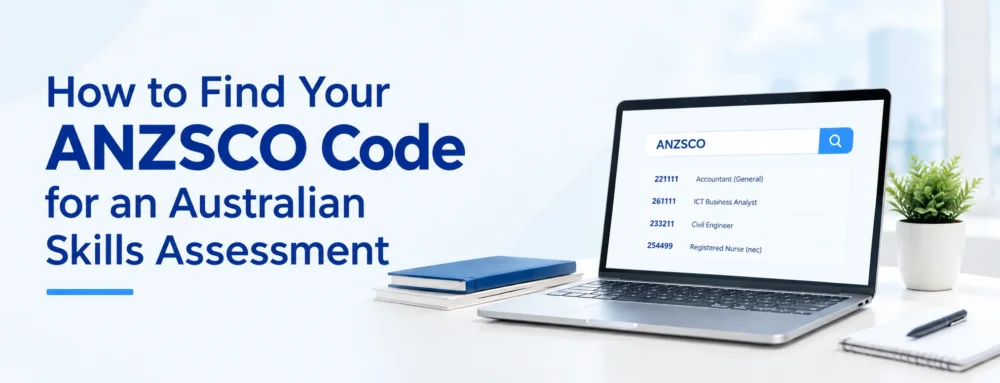
Identifying the occupation that corresponds to your qualifications, experience in the labor market, and actual job responsibilities is an integral stage of preparing for skills assessment in Australia.
Learning how to find ANZSCO code that matches your professional experience is not about finding a suitable occupation in a long list of codes. In some cases, your employer might be using a different job title than the ANZSCO code name. In addition, even if there are two occupations sharing the same job title, their tasks can vary greatly.
Whether you are applying for an Independent Skilled Visa (Subclass 189), a Skilled Nominated Visa (Subclass 190), or a Skills in Demand Visa (Subclass 482), this 2026 guide explains step-by-step how to find ANZSCO code designations that match your true professional experience, helping you conduct an effective ANZSCO occupation search.
Major Key Highlights
- Task-Based Approach: It is your true daily tasks, not your job title, that will determine how you find ANZSCO occupation code matches.
- Dual ANZSCO and OSCA Classification System (2026 Revision): Even though the ABS implemented OSCA 2024 for statistical purposes, the Department of Home Affairs still uses ANZSCO 2022 (e.g., Subclass 186/482) and ANZSCO 2013 (e.g., Subclass 189/190/491), depending on the visa stream.
- Evaluating Assessing Authorities’ Requirements: To identify the right code, compare the occupation descriptions with the criteria set by your assessing authority (e.g., ACS, TRA, VETASSESS).
- Avoiding Risk of Assessment Failure: Choosing the wrong code or including the official task lists in your reference letters may lead to refusal of your skills assessment and visa application.
What Is an ANZSCO Code?
The Australian ANZSCO (Australian and New Zealand Standard Classification of Occupations) coding scheme is an occupation coding system whereby occupations are classified according to skill level and skill specialization.
ANZSCO classification of occupations involves hierarchical structuring:
- Major Group (1st digit): Skill level category
- Sub Major Group (2nd digit): Industry specialization.
- Minor Group (3rd digit): Specialization of field.
- Unit Group (4th digit): Related occupations.
- Individual Occupational Group (5th and 6th Digits): 6-Digit Coding.
ANZSCO Code Example
An entry in ANZSCO has a title, alternative titles, a statement of main duties, skills levels, specialization titles, and task examples. Performing a targeted ANZSCO code search is the most reliable way to identify ANZSCO code entries that accurately describe the daily work you perform.
Which ANZSCO Version Will Be Applicable for Your Australian Visa in 2026?
It is a very important point to consider while looking for an entry in the ANZSCO occupations list now. While the ABS has moved to OSCA 2024 for its data reporting, the Department of Home Affairs has indicated that two separate ANZSCO versions will apply in the skilled visa program:
- ANZSCO 2022: It will apply to the Employer Nomination Scheme visa (subclass 186) and Skills in Demand visa (subclass 482), which include occupations from the Core Skills Occupation List (CSOL).
- ANZSCO 2013: It will apply to other skilled visa subclasses, which are mentioned in the occupation lists like MLTSSL, STSOL, and ROL (such as subclasses 189, 190, and 491).
3 Critical Reasons to Find ANZSCO Code Classifications That Match Your Work History
Selecting an occupation that accurately reflects your professional background is critical because occupation requirements directly govern your migration pathway:
- Determines Visa Relevance: Home Affairs specifies which occupations are open for specific visa subclasses. Selecting an incorrect code can exclude you from state nominations or permanent residency pathways.
- Identifies Your Assessing Authority: Each listed occupation is paired with a designated skills assessment body (e.g., VETASSESS, ACS, TRA, Engineers Australia). Selecting a different code may route your application to an authority with entirely different criteria.
- Ensures Evidence Integrity: Your employment reference letters, contracts, and tax records must support your claimed occupation. Mismatches between claimed codes and actual duties can create serious difficulties during assessment.
How to Find ANZSCO Code Matches: A Step-by-Step Guide

Step 1: Start by Describing the Actual Job Responsibilities
Before starting with the ANZSCO Code search, describe in detail the things that you actually do or did while working in your job. Do not think about your pay scale designation for the time being, but make a detailed list of your actual responsibilities:
- Primary duties done daily/weekly.
- Specific technical tools/software/methodologies.
- Technical responsibility and authority level.
- Managerial/ supervisory/ client responsibilities.
For instance, an employee who is designated as “Operations Specialist” can have responsibilities related to logistics, administrative management, procurement, or IT services. The important first step to find ANZSCO occupation code options is understanding the core nature of your job rather than its payroll title.”
Step 2: Use Official Resources to Find ANZSCO Code Options
Now that you have documented your duties, you can conduct a focused ANZSCO occupation search across official databases like the Department of Home Affairs ANZSCO occupation list and the ABS classification tool.
If you are searching for an occupation in ANZSCO, then you need to use functional language instead of a job title:
Rather than searching for a “Manager” position in general, try searching for:
- Supply chain
- Database administration
- Software development
- Structural engineering
- Marketing or Accounting
Step 3: Read the Full Occupation Description
In evaluating the chosen occupation from the shortlist, evaluate all elements available in the occupation:
- Principal Title: The main title for the occupation.
- Alternative Titles: The title with the same meaning as the principal title.
- Lead Statement: This is the summary that defines the essence of the occupation.
- Indicative Tasks: Examples of the tasks performed in the occupation.
- Skill Level: The skill level needed to complete the tasks.
- Specialization Titles: Specialized occupations within the occupation.
The Australian Bureau of Statistics advises that the task list is indicative and representative and not an exhaustive list of tasks to be done. It is not necessary to undertake all listed tasks, although the lead statement and indicative tasks should match your job.
Step 4: Compare Your Duties With the Occupation
Compare your documented work history against the classification components:
| Your Work Background | ANZSCO Classification Information |
|---|---|
| Main Responsibilities | Lead Statement |
| Regular Tasks & Tools | Indicative Tasks |
| Qualifications & Years of Work | Indicative Skill Level |
| Specialized Duties | Specialisation Titles |
Look at the overall nature of the work. Avoid altering your employment documents to mirror classification text artificially. Assessing bodies expect authentic evidence describing what you genuinely performed in your role.
Step 5: Check the ANZSCO Skill Level
ANZSCO classifies occupations into five broad skill levels based on formal education, training, and experience:
| ANZSCO Skill Level | General Australian Qualification Indication | Equivalent Experience Alternative |
|---|---|---|
| Skill Level 1 | Bachelor’s degree or higher qualification | Relevant experience may substitute in some cases |
| Skill Level 2 | AQF Associate Degree, Advanced Diploma, or Diploma | Relevant experience may substitute in some cases |
| Skill Level 3 | AQF Certificate IV, or Certificate III with on-the-job training | Relevant experience may substitute in some cases |
| Skill Level 4 | AQF Certificate II or III | Relevant experience may substitute in some cases |
| Skill Level 5 | AQF Certificate I or compulsory secondary education | Short on-the-job training |
Note: The skill level is an attribute of the occupation classification itself, not a personal rating of an individual’s competence.
Step 6: Review Alternative Titles to Choose ANZSCO Code Profiles
Your job title might not necessarily be identical to the main title under the classification. For example, the title “Lead Systems Architect” internally used within the organization can refer to different occupations in unit groups based on what the primary activity is, be it software engineering, database design, or systems analysis.
Considering alternative titles enables you to choose ANZSCO code classifications that reflect your functional role regardless of your corporate job title.
Step 7: Compare Similar ANZSCO Occupations
It is common in fields like IT, engineering, marketing, and administration to find multiple overlapping occupations. Performing a side-by-side comparison ensures you select the most appropriate option.
Example: Comparing Similar ICT Roles
| Area to Compare | Developer Programmer (261312) | Software Engineer (261313) | Analyst Programmer (261311) |
|---|---|---|---|
| ANZSCO Code Australia Classification | Unit Group 2613 | Unit Group 2613 | Unit Group 2613 |
| Core Focus | Writing, testing, and maintaining code. | Designing, evaluating, and architecting software systems. | Analyzing user requirements and writing code specs. |
| How to Identify ANZSCO Code Fit | Primary focus on script writing & debugging. | Primary focus on software design logic. | Primary focus on requirement analysis. |
Step 8: Check the Relevant Skills Assessment Authority
Identifying a matching description in ANZSCO is only one part of the process. You must also check the requirements of your designated assessing authority, such as:
- VETASSESS: For various professional, administrative, and technical occupations.
- Australian Computer Society (ACS): For Information and Communications Technology (ICT) roles.
- Trades Recognition Australia (TRA): For trade occupations.
- Engineers Australia (EA): For engineering professions.
Assessing authorities frequently apply specific criteria such as minimum post-qualification experience or core unit requirements that go beyond general ANZSCO definitions.
Step 9: Verify the Occupation Against Your Visa Pathway
Before finalizing your choice, verify your occupation against your target visa requirements:
- ➜Which visa subclass are you applying for?
- ➜Which ANZSCO version (2013 or 2022) applies to that subclass?
- ➜Is your occupation listed on the active skilled occupation list for that visa?
- ➜Do you meet the designated assessing authority’s specific criteria?
- ➜If seeking state nomination (e.g., Subclass 190/491), is the occupation currently open in your target jurisdiction?
Documents Needed Before You Choose ANZSCO Code Designations
To ensure your evidence supports your claimed code, review and gather:
Employment Documents
- Official employment contracts and statements of service.
- Detailed employer reference letters signed by managers.
- Position descriptions and organizational charts.
Payroll & Financial Evidence
- Official payslips and tax assessment notices.
- Pension or superannuation contribution records.
Academic Documents
- Degree certificates and complete academic transcripts.
Common Pitfalls When You Try to Find ANZSCO Code Matches
- Relying Only on Job Titles: Internal job titles often do not reflect standardized ANZSCO classifications.
- Ignoring the ANZSCO Version: Assuming the newest ABS classification (OSCA 2024) automatically applies to Home Affairs visas, rather than checking whether ANZSCO 2013 or 2022 is specified.
- Copying ANZSCO Wording Verbatim: Copying task statements word-for-word into employment reference letters can lead assessing bodies to question the authenticity of your evidence.
- Selecting a Code Based Only on Nomination Availability: Claiming an occupation solely because a state is nominating it without having matching experience carries significant assessment risk.
- Ignoring Assessing Authority Guidelines: Relying strictly on ABS classification text without reviewing the assessing authority’s guidelines.
ANZSCO Code vs Job Title: Key Differences
- Job Title: An internal name assigned by an employer for corporate structure, payroll, or business operations (e.g., “Growth Marketing Lead”).
- ANZSCO Code: A standardized national classification code based on skill level, skill specialization, and defined core tasks (e.g., “Digital Marketing Specialist”).
Final ANZSCO Verification Checklist
- ☑Have I documented my main daily employment duties?
- ☑Have I searched the occupation classification relevant to my visa?F
- ☑Have I verified whether ANZSCO 2013 or ANZSCO 2022 applies to my visa subclass?
- ☑Have I reviewed the lead statement and indicative tasks?
- ☑Have I reviewed alternative titles and specializations?
- ☑Have I identified and checked the requirements of the listed assessing authority?
- ☑Do my employment documents accurately describe my real duties without copying ANZSCO text verbatim?
When May Professional Assistance Be Useful?
Additional professional guidance can be beneficial if:
- Your corporate job title does not clearly correspond to an ANZSCO occupation.
- Your role combines responsibilities across multiple distinct professional fields.
- Your academic qualifications differ from your primary employment field.
- You are uncertain which ANZSCO version or assessing authority applies to your visa pathway.
Frequently Asked Questions (FAQs)
Q1: Can I choose an ANZSCO code based only on my job title?
No. To find ANZSCO code matches accurately, you must focus on daily tasks and core responsibilities rather than internal designations.
Q2: How do I find ANZSCO occupation code options if my job title isn’t listed?
If your title is missing from the ANZSCO occupation list, review lead statements, indicative tasks, and alternative titles to identify ANZSCO code entries aligned with your actual duties.
Q3: Which ANZSCO version should I use in 2026?
The applicable version depends on your visa subclass. The Department of Home Affairs specifies ANZSCO 2022 for Subclasses 186 and 482 (CSOL) and ANZSCO 2013 for other skilled visa subclasses (e.g., 189, 190, 491).
Q4: Is ANZSCO still used even though the ABS introduced OSCA?
Yes. While the ABS introduced OSCA 2024 for statistical purposes, Home Affairs continues to specify ANZSCO versions for skilled migration visas.
Q5: Do all my duties have to match the ANZSCO task list?
No. ANZSCO task lists are representative and indicative rather than exhaustive checklists. However, your role should align substantially with the lead statement and core tasks, while meeting your assessing authority’s specific criteria.