Understanding how remote work experience Australia migration plays a central role for professionals seeking to leverage off-site employment when moving down under.
Remote employment has become common across technology, consulting, design, finance, education, and many other professional industries.
As a result, skilled workers exploring remote work experience Australia migration options often ask: Can off-site employment history be claimed when applying for an Australian skilled visa or skills assessment?
The answer depends on more than whether a person worked from home or outside a traditional office. The relevant visa pathway, nominated occupation, employment arrangement, period of employment, location where the work was performed, and the evidence available to support the employment claim can all matter.
Key Highlights
-
Location Determines Classification: Physical location dictates classification for remote work experience Australia migration claims; working remotely from overseas for an Australian employer counts as offshore experience, not onshore work experience.
-
Evidence Beyond Contracts is Essential: An employment letter or contract alone is not enough; assessing authorities (like ACS and VETASSESS) require independent payment proof (payslips, bank statements, tax records) to approve remote work experience australia migration claims.
-
Strict Hours and Role Alignment Apply: To count toward points or skills assessments, remote work must be paid, meet minimum weekly hours (typically 20+ hours/week), and directly match your nominated ANZSCO occupation tasks.
What Is Remote Work Experience?
Remote work experience generally refers to employment or professional work performed away from the employer’s traditional workplace. This can include:
- Working from home for an Australian employer
- Working remotely for an overseas employer
- Working from one country for an employer located in another country
- Working remotely as an employee
- Working as an independent contractor or freelancer
- Working in a hybrid arrangement where some duties are performed remotely
However, the word “remote” does not itself determine whether an employment period qualifies for migration purposes.
The core assessment criteria: The more important questions are whether the work was genuine and paid, whether the duties are relevant to the occupation being claimed, whether the employment meets the applicable requirements, and whether the applicant can provide reliable evidence.
Can Remote Work Experience Count for Australian Migration?
Potentially, yes, but remote work experience Australia migration approval is not automatic simply because your off-site role was full-time or performed for a recognized company.
When considering remote work experience Australia migration, applicants should examine several factors:
- The visa pathway
Different skilled and employer-sponsored visas have different eligibility requirements. For example, SkillSelect applies to points-tested visas including subclasses 189, 190 and 491, while other skilled pathways have their own requirements. - The nominated occupation
Your duties must directly align with specified ANZSCO codes. Australian skilled migration uses specified occupation lists and corresponding assessing authorities for different visa programs. - The nature of your employment
Freelance, employee, and contractor arrangements carry different documentary burdens under remote work experience Australia migration guidelines. - The period and hours of employment
The applicable requirements for employment duration and working hours depend on the relevant pathway and assessing authority.For example, ACS currently defines full-time work for its migration skills assessment as 20 hours or more per week and requires evidence of paid employment. VETASSESS also uses a 20-hour-per-week benchmark for relevant professional employment, subject to its applicable requirements.
This does not mean that 20 hours is a universal rule for every Australian migration pathway. Applicants should always check the requirements that apply to their specific occupation and visa.
How Assessing Authorities Evaluate Remote Work Experience for Australia Migration
Working remotely does not create a separate universal “remote work” skills-assessment category.
Instead, the relevant assessing authority generally looks at whether your qualifications, employment, and duties meet the requirements of the occupation and assessment pathway.
- ACS: Requires evidence verifying paid employment, including employer documentation and evidence of payment. ACS also states that the work must be at a professional IT level and directly related to the nominated occupation.
- VETASSESS: Requires detailed Statements of Service, tax documents, and project logs. Statutory declarations alone will not satisfy remote work experience Australia migration requirements.
Therefore, applicants should focus on proving the substance of their employment, rather than assuming that the remote nature of the job is either automatically acceptable or automatically disqualifying.
Scenario 1: Remote Work for an Australian Employer While Overseas
One common situation is an applicant who lives outside Australia but works remotely for an Australian company.
Applicants pursuing remote work experience Australia migration pathways should not assume that an employer’s Australian location automatically qualifies their offshore work as Australian experience.
Employer’s location
Employment relationship
Occupation and duties
Relevant visa requirements
Skills-assessment requirements
Supporting evidence
The treatment of employment for remote work experience for Australian migration can depend on the specific purpose for which the experience is being claimed.
Scenario 2: Remote Work Experience Australia Migration for Overseas Employers
Another common situation involves a person who works remotely for a company located outside Australia.
When evaluating remote work experience Australia migration eligibility for overseas employers, the primary focus is proving that your employment meets ANZSCO skill levels and paid-hour requirements.
Department of Home Affairs Requirement: Detailed evidence of employment history is strictly required in relevant skilled visa applications. Examples include bank statements, payslips, and tax statements; a work reference alone is not sufficient to prove work history.
Remote Employee vs Contractor vs Freelancer
The term “remote worker” can describe several different employment arrangements.
Remote Employee
A remote employee generally has an employment relationship with an organisation and may have:
- An employment contract
- Regular salary payments
- Payslips
- Employer-issued employment records
- An authorised employer reference or Statement of Service
Independent Contractor / Freelancer
A contractor or freelancer may instead have:
- Service agreements & client contracts
- Invoices & bank payment records
- Tax records
- Business registration documents
- Client or professional evidence supporting the work performed
VETASSESS states that self-employed applicants, including contractors and freelancers, can be assessed in relevant circumstances, but they need appropriate documentary evidence. Its guidance includes evidence from an accountant or legal practitioner, payment records, contracts, client testimonials and project evidence.
This is why an applicant should not simply copy the evidence checklist of a salaried employee when preparing a remote employment skills assessment for self-employment.
What Evidence Can Support Remote Work Experience?
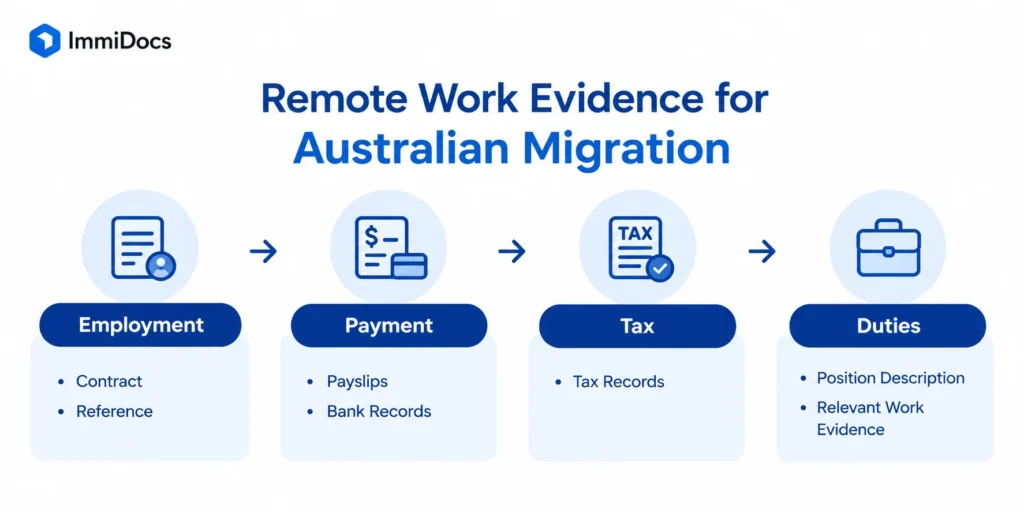
Key Facts Your Documentation Must Establish:
- Employment contract: Can establish the terms of the employment relationship, position, and other relevant conditions. (Note: An employment contract alone may not be enough.)
- Employment reference or Statement of Service: A detailed Statement of Service serves as critical proof for remote work experience Australia migration claims, outlining your exact start dates, weekly hours, remuneration, and main duties.
- Payslips: Help demonstrate that the employment was paid.
- Bank statements: Help connect salary or other employment payments with the claimed employment period.
- Tax records: May provide independent evidence of income and employment.
- Other supporting documents: Position descriptions, business registration documents, client contracts, invoices, project evidence, professional records, and other official employment documentation.
How Is Remote Work Experience Assessed for Different Occupations?
There is no single assessment rule that applies to every occupation.
IT occupations and ACS
For applicants whose nominated occupation is assessed by the Australian Computer Society, ACS requires evidence of paid employment, including employer documentation and payment evidence.
ACS also assesses whether the employment is at a professional IT level and directly related to the nominated occupation.
Therefore, an IT professional preparing a remote work experience skills assessment should review the current ACS requirements rather than relying on a generic remote-work checklist.
Professional occupations assessed by VETASSESS
VETASSESS requires specific employment evidence for professional occupations. Its current guidance includes employer statements, payment evidence and supporting documents.
It also states that statutory declarations cannot be the sole basis for establishing employment claims.
For self-employed professional applicants, VETASSESS may require evidence such as accountant or legal-practitioner statements, payment records, client contracts and project evidence.
Other assessing authorities
Applicants in engineering, accounting, trades and other occupations may be assessed by different authorities. The documentary requirements can therefore vary significantly.
Before submitting a Remote Work Skills Assessment Australia application, check the current requirements of the authority responsible for your nominated occupation.
Does Remote Work Count Toward Skilled Migration Points?
For points-tested visas (subclasses 189, 190, and 491), work experience can significantly boost your overall score. However, claiming points under remote work experience Australia migration criteria requires solid documentation. Simply holding an employment contract is insufficient; Home Affairs requires verifiable bank statements, tax records, and official pay slips.
Home Affairs also states that meeting the minimum points threshold does not guarantee an invitation to apply.
How to Prepare Your Remote Employment Evidence
A practical preparation process can help reduce inconsistencies in an application.
1
2
3
4
5
6
7
8
Common Mistakes When Claiming Remote Work Experience
- Assuming remote work automatically qualifies: Assuming off-site jobs automatically qualify: Remote employment is not a separate pathway, so every remote work experience Australia migration claim must meet standard ANZSCO guidelines.
- Relying only on an employment reference: Home Affairs states that a work reference alone is not enough to prove employment history for relevant skilled visa applications.
- Ignoring the assessing authority: Different occupations can have different skills-assessment requirements.
- Confusing employer location with work location: The fact that a company is Australian does not, by itself, answer every question about how employment should be treated.
- Providing inconsistent dates: Employment dates should match across contracts, references, payment records and other documents.
- Treating contractor evidence like employee evidence: Freelancers and self-employed applicants may need different types of documentation.
- Assuming the 20-hour rule applies to every pathway: Some assessing authorities use a 20-hour benchmark, but applicants should not turn that into a universal rule for every visa or migration claim. ACS and VETASSESS, for example, have specific guidance referring to 20 hours per week in relevant assessment contexts.
- Using a statutory declaration as a substitute for all evidence: A statutory declaration may support certain claims, but it does not necessarily replace official employment and payment evidence. VETASSESS specifically states that assessments cannot be based on statutory declarations alone.
Document Checklist for Your Remote Work Experience Australia Migration Application
Before preparing your application, consider whether you have appropriate evidence for the employment period you intend to claim.
Primary Employment Evidence
- Employment contract
- Statement of Service or employer reference
- Position description
- Employment dates
- Job title
- Working hours
- Salary or remuneration details
Financial Payment Evidence
- Payslips
- Bank statements
- Tax records
- Other official payment records
Contractor / Self-Employment
- Business registration
- Client contracts
- Invoices
- Bank records
- Accountant or legal-practitioner evidence where required
- Client testimonials
- Project evidence
Migration Documents
- Skills assessment outcome, where required
- English-language evidence, where applicable
- Qualification documents
- Accurate employment history
- English translations for non-English documents (Home Affairs provides specific translation requirements)
Conclusion
For applicants researching remote work experience Australia migration, the key is to look at the complete picture: the visa pathway, nominated occupation, employment arrangement, work period, applicable skills-assessment requirements and documentary evidence.
A well-prepared application should present a clear and consistent employment history supported by appropriate records. Home Affairs and VETASSESS all emphasise the importance of evidence when employment history is being claimed.
Frequently Asked Questions
1. Can remote work experience count for Australian migration?
Yes, remote work may count if it meets the relevant visa, occupation and skills-assessment requirements.
2. Does working remotely for an Australian company automatically count as Australian work experience?
No, the employer’s location alone does not determine whether the experience qualifies for a particular migration purpose.
3. What documents can prove remote work experience Australia migration?
Evidence may include employment contracts, employer references, payslips, bank statements, and tax records, depending on the relevant requirements.
4. Is 20 hours per week enough for remote work experience?
For some skills assessments, including ACS and VETASSESS requirements, paid work of at least 20 hours per week may meet the minimum full-time benchmark.
5. Can freelancers and contractors use remote work experience?
Yes, some assessing authorities may accept self-employment or contract work when the required evidence and eligibility criteria are met.
6. Can I use bank statements as evidence of remote employment?
Yes, bank statements can support employment and payment claims, but they may need to be accompanied by other required evidence.
7. Does working remotely while in Australia require checking visa conditions?
Yes, you should check your visa conditions before working in Australia because work rights can vary between visa types.
8. Do I need a skills assessment for Australian skilled migration?
It depends on the visa and nominated occupation, as many skilled pathways require a relevant skills assessment while some pathways have different requirements.