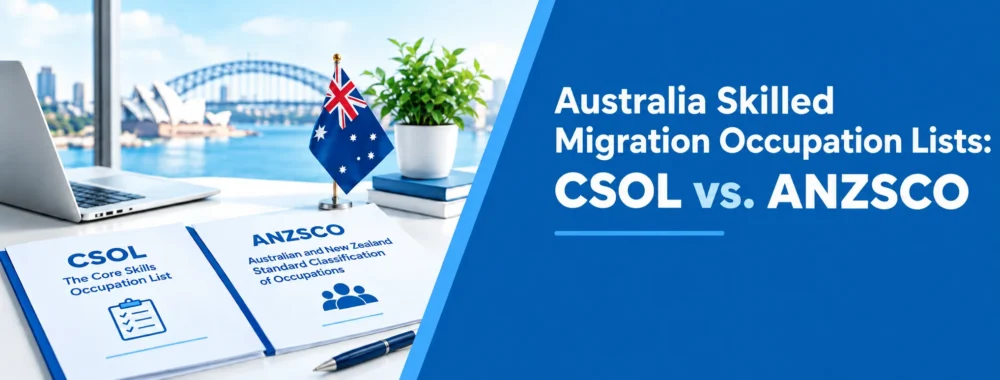
Trying to navigate through the skilled migration system of Australia will surely seem as complicated as solving a matrix. With the coming into effect of many legislative changes and stream consolidations in 2026, which include the use of the Core Skills Occupation List (CSOL) in addition to the ANZSCO occupation codes Australia, it is important that you understand how the two systems work together.
When you aim to migrate through an employer-sponsored stream such as the Skills in Demand visa (Core Skills stream) or even through the Employer Nomination Scheme (Subclass 186) to gain permanent residence, it becomes imperative for you to understand the CSOL vs ANZSCO structure.
This ultimate guide will help you understand the CSOL and ANZSCO difference, as well as how assessing authorities like VETASSESS evaluate your credentials.
Major Key Highlights
Here is a summary of the key points everyone who is planning on applying should know in 2026 before moving on to more technical details:
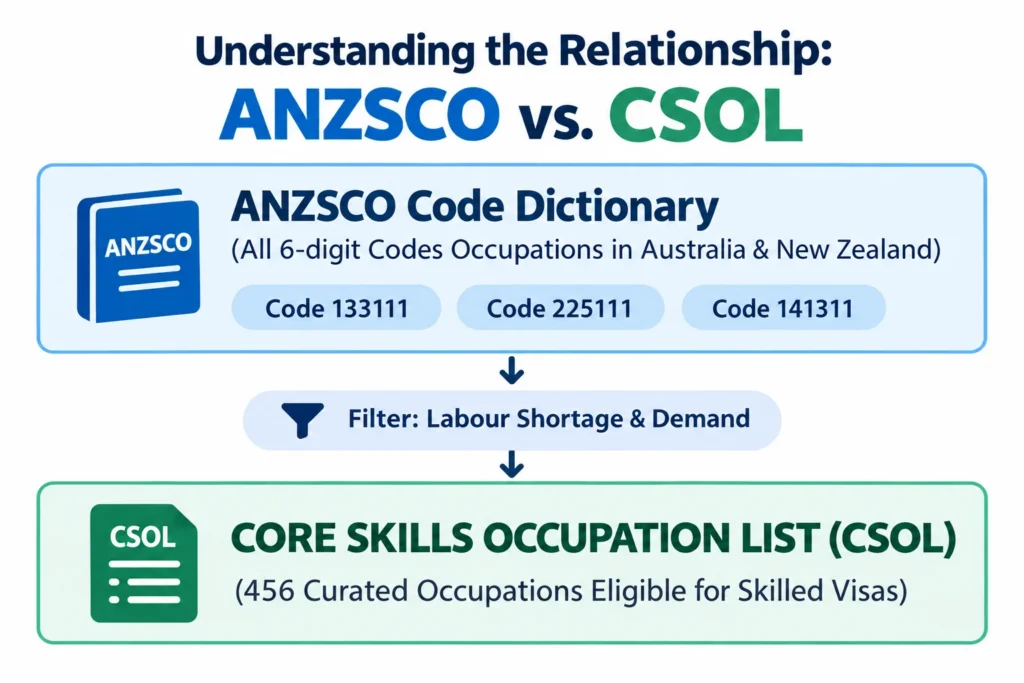
- ANZSCO is a Classification Scheme; CSOL is a List of Occupations: ANZSCO classifies and describes the duties for all the jobs in Australia and New Zealand, while CSOL includes a carefully selected list of 456 occupations that are eligible for particular skilled visas.
- Important in Employer Nomination Scheme: The CSOL occupation list is one of the foundations of the Skills in Demand visa (Core Skills stream) and the Subclass 186 Direct Entry stream.
- Skills Assessment Needed: In order to migrate based on the CSOL occupational code, you will have to prove that your skills and experience relate to an ANZSCO code through skilled assessment conducted by an appropriate organization such as VETASSESS.
- Combination of Two Instruments: You cannot choose CSOL or ANZSCO Australia; ANZSCO is used to determine the duties of your job, while CSOL is used to see if Australia is sponsoring this occupation.
Deconstructing the Frameworks: What Are CSOL and ANZSCO?
To build a solid migration strategy, you must first understand the fundamental definitions of these two critical tools.
What is an ANZSCO Code?
The Australian and New Zealand Standard Classification of Occupations (ANZSCO) is a comprehensive directory that classifies all formal jobs in the economy.
Each occupation gets its unique number, called an ANZSCO code for skilled migration, and it includes:
- Lead Statement: A brief statement about the main purpose of the profession.
- Task List: The list of tasks performed in the job.
- Skill Level: The level of education and years of experience needed to perform this occupation (from Skill Level 1, which means a bachelor’s degree or higher, to Skill Level 5).
What is CSOL?
The Core Skills Occupation List (CSOL) is a dynamic and policy-driven list created by the Australian Department of Home Affairs and supported by Jobs and Skills Australia (JSA).
It includes 456 occupations that are in high demand and face labor shortages across the country.
The CSOL occupation list is used to determine which occupations are eligible for particular employer-sponsored visas. Unlike fixed encyclopedias, the CSOL list is regularly updated to meet the changing needs of the market, infrastructure development, technology advancements, and health care sectors.
CSOL vs ANZSCO: Understanding the Core Differences
Most people get confused about this issue because they confuse classification with being eligible for a policy. For instance, we can look at the ANZSCO list as a dictionary that contains all the job titles and descriptions in the world. However, CSOL is like a menu, picked out from this dictionary, of all those jobs that an Australian employer can sponsor.
Key Functional Differences
| Feature | ANZSCO | CSOL |
|---|---|---|
| Primary Purpose | Classifies and defines job roles, benchmark duties, and skill levels. | Determines visa eligibility for specific skilled migration pathways. |
| Scope | Covers all occupations in the Australian economy. | Covers a selective subset of 456 high-demand occupations. |
| Updating Body | Australian Bureau of Statistics (ABS) / Statistics NZ. | Department of Home Affairs & Jobs and Skills Australia. |
| Identifier Format | 6-Digit Numerical Code (e.g., 225111 for Advertising Specialist). | Uses existing ANZSCO occupation codes in Australia linked to visa conditions. |
| Primary Use in Migration | Benchmark for performing a successful CSOL skills assessment. | Verifies if an employer can nominate you for a visa. |
How CSOL and ANZSCO Work Together in Your Visa Application
The process of comparing CSOL vs ANZSCO is not only of an educational nature but also determines how your visa application will be prepared.
Here is how the two systems work together throughout the process of immigration:
Step 1: Duties Matching through ANZSCO
Prior to consulting visa occupation lists, one needs to check ANZSCO occupation codes Australia to see which job title matches one’s work experience. One needs to make sure that one’s previous work history corresponds to 65% to 80% of the benchmark duties as described for this particular ANZSCO code in skilled migration.
Step 2: Confirmation on the CSOL List
After identifying your code, you need to see whether it exists on the current CSOL occupation codes list. If your profession belongs to the Core Skills Occupation List, then you can proceed to apply for employer-sponsored visas under the Core Skills stream.
Step 3: Performing CSOL Skills Assessment
Before lodging your visa application, you need to pass a skills assessment provided by the appropriate assessing authority. In the case of hundreds of general professions and managerial and administrative positions, it is VETASSESS.
When reviewing your application, VETASSESS compares your academic qualifications, transcript, and employment references to the benchmark duties described for your nominated CSOL occupation.
Navigating VETASSESS for CSOL Occupations
As Australia’s largest skills assessment body for professional occupations, VETASSESS assesses a large number of occupations on the CSOL occupation list. It takes adequate preparation to have your CSOL skills assessment done by VETASSESS.
VETASSESS Assessment Criteria
While preparing your profile for CSOL skills assessment, VETASSESS considers the following two criteria:
Educational Qualification
The qualification you possess should be evaluated to be equivalent to the AQF requirement for the skill level of your ANZSCO. Besides that, the field of study should match the selected occupation.
Employment Relevance & Currency
- Task Alignment: Your official reference letters should provide evidence about your performance of tasks related to the nominated ANZSCO code for skilled migration.
- Post-Qualification Experience: The time period since you obtained your qualification is limited to 5 years, and during this time you should have accumulated enough paid work experience in your nominated occupation.
Common Pitfalls When Selecting Your ANZSCO and CSOL Code
Minor mistakes made during the occupation mapping phase can result in delayed processing times or visa rejections. Some of the common mistakes to watch out for:
- Mapping By Title Rather Than Responsibility: Job titles differ considerably between firms and countries. VETASSESS and the Department of Home Affairs do not consider titles but evaluate job responsibilities as per ANZSCO guidelines.
- Failure to Consider Prerequisites of Skill Level: If an ANZSCO occupation requires a Bachelor’s degree (Skill Level 1) and you only have a Diploma, you will likely miss out unless you have qualifying experience recognized by the assessor.
- Thinking CSOL Also Applies To Independent Pathways: Take note that the CSOL applies mostly to employer-sponsored categories like the Skills in Demand and 186 Direct Entry visa programs. Independent points-based pathways (such as Subclass 189) have their own occupation lists, which include MLTSSL.
- Using Outdated Codes: Immigration regulations keep changing. Always make sure your target occupation is active on official lists when submitting your applications.
Strategic Checklist for Skilled Applicants in 2026
To streamline your journey through the CSOL vs ANZSCO Australia framework, follow this step-by-step checklist:
- Obtain Detailed Employment Statements: Request comprehensive reference letters on company letterhead detailing your exact duties, employment dates, hours worked per week, and salary.
- Identify Your Primary ANZSCO Code: Cross-reference your employment statements with the official ANZSCO duty descriptions.
- Verify CSOL Eligibility: Search the active database of CSOL occupation codes to confirm your code is open for sponsorship.
- Prepare Your VETASSESS Documentation: Collate certified copies of degree certificates, transcripts, payslips, tax records, and bank statements showing salary payments.
- Apply for a CSOL Skills Assessment: Submit your complete portfolio to VETASSESS or your specific assessing authority.
- Connect with Approved Sponsoring Employers: Once you have a positive skills assessment, engage with Australian employers eligible to sponsor overseas talent under the Core Skills stream.
Frequently Asked Questions(FAQs)
1. How to get the correct ANZSCO code for my occupation in skilled migration?
You can look up both ABS and Department of Home Affairs directories based on your job responsibilities rather than simply using your job title.
2. Is a skills assessment by VETASSESS mandatory for all CSOL occupations?
Not necessarily, but yes, it is required for many of them. VETASSESS assesses about 350 occupations, whereas some professions have designated assessor bodies, such as Engineers Australia or ACS (Australian Computer Society).
3. Will I be able to apply for the visa if my profession falls under ANZSCO classification, but does not belong to CSOL?
You will not be able to apply for the relevant visa via CSOL-based streams such as the Core Skills Stream. However, you may still be able to apply via State Nominated and Regional visas provided that your occupation is on the corresponding lists.
4. How frequently are CSOL occupation codes reviewed by the government?
The CSOL occupation codes are periodically reviewed and updated by Jobs and Skills Australia (JSA).
5. What will happen if my occupation is delisted from CSOL while my skills assessment is being processed?
You won’t be able to apply for the visa through that stream anymore.