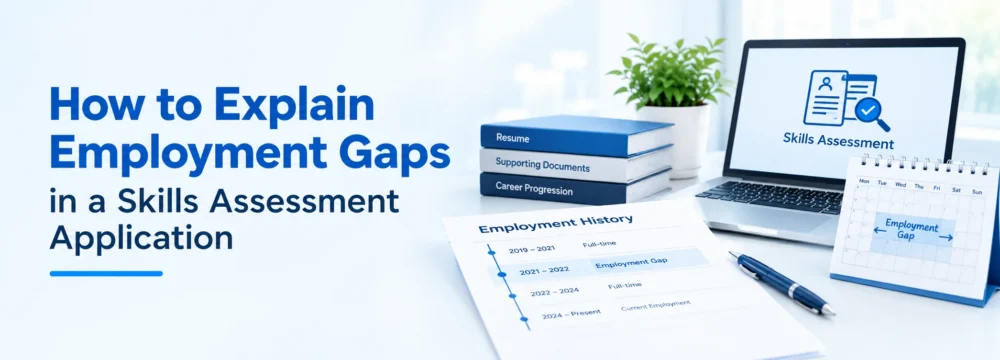
Creating a skills assessment application might prove difficult if you have employment gaps or lack some documents. A VETASSESS employment gap explanation should accurately describe the period when you were not working and the circumstances surrounding the break.
One must not confuse an employment gap with a situation where one was employed but lacks some documentation to prove their employment.
When preparing an explanation for employment gaps in a skills assessment, it is important to distinguish between a genuine period of unemployment and a period of employment for which documentation is missing.
Key Highlights
-
Understanding Employment Gaps: Learn how to present your employment gaps effectively and submit valid supporting documents for your skills assessment.
-
Common Reasons for Career Breaks: Explore how to describe gaps related to further education, family responsibilities, health, or unemployment.
- Employment Timeline Evidence: Understand how to organise your work history and identify potentially relevant supporting documents.
- Writing an Employment Gap Explanation: Learn how to present the dates, circumstances and supporting information clearly.
- Document Preparation Support: Discover how ImmiDocs can assist with organising employment records and preparing relevant documentation.
What Is a VETASSESS Employment Gap Explanation?
An employment gap is the time frame when you were not working between two jobs or at another point in your career. The cause of employment gaps might be due to more studies, family duties, medical leave, moving locations, redundancy, or a conscious choice to take time off.
But there is a difference between an employment gap and a lack of proof of employment. It is possible for you to have been working all along but have no reference letter, payslips, or any other evidence from your former employer.
A VETASSESS employment gap explanation should provide an accurate account of your employment history, including the dates and circumstances of any periods when you were not working. Keep the explanation consistent with your supporting documents and the requirements of your nominated occupation and assessment pathway.
Why Employment Gaps Matter in a VETASSESS Skills Assessment
After you submit an application through VETASSESS, they do more than just verify whether you hold a degree; instead, they thoroughly document your employment history in order to determine how many years you have worked as a skilled professional in your nominated ANZSCO code (or a closely related industry).
The skilled migration process for Australia has strict requirements, and points are awarded based on the number of years of experience you have.
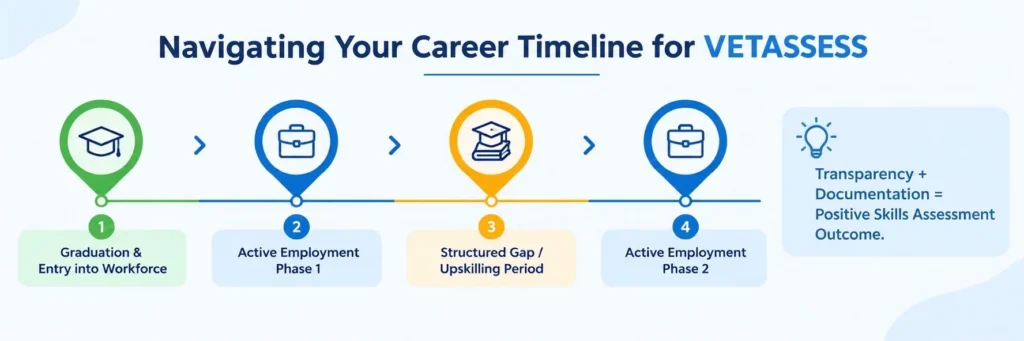
When preparing an explanation for employment gaps in a skills assessment, make sure your employment history clearly identifies periods of work and periods when you were not employed. This helps the assessor understand your timeline and distinguish claimed employment experience from career breaks.
In addition to these, assessing authorities will also need:
- Skill Currency: Whether your skills have diminished during long periods of inactivity.
- Consistency with Tax/ Legal Records: Whether your work history is consistent with tax/legal documents.
- Post-Qualification Consistency: Whether the claimed work experience occurred after completing your necessary education qualification.
Unclear dates or inconsistencies between your employment history and supporting documents may require clarification. Explain relevant gaps accurately and provide supporting evidence where appropriate and available.
Common Causes of Employment Gaps in a Skills Assessment
Not all career interruptions are viewed the same way. VETASSESS understands that human lives involve transitions, personal responsibilities, and unforeseen events. The key is how you frame and substantiate these periods.
1. Further Education and Training During Employment Gaps
Should you have taken a break from the job market to pursue a postgraduate program, specialized certification, or even intensive technical education, it could be a reason for the gap.
- How to present this: Describe the gap as part of strategic career improvement.
- Required evidence: Academic records and certificates of completion or enrollment with proper dates.
2. Family Obligations and Parental Leave
Time taken off to raise children, take care of your older parents, or perform domestic tasks is very much normal and legitimate.
- How to present this: Clearly state that your break was devoted to looking after your family. It is fine if you have made personal decisions as far as the period of active employment required to obtain immigration points goes.
- Required evidence: Though employment reference letters would not work in this case, personal statements or certificates attesting to your medical/family situation might be added as evidence.
3. Medical and Health-Related Time Off
It often takes time to recuperate from an illness or recover from an injury.
- How to present this: Stay professional; you do not need to give out any medical information to explain the gap, but mention sabbatical or redundancy notices, or registration documents from local employment offices.
- Evidence required: Doctor’s certificates, medical clearance letters, or hospital discharge summaries confirming the timeframe of incapacity.
Work History Gaps in Australia: Employment Timeline Evidence
For work history gaps in Australia, a chronological record can help you identify periods that may need clarification and organise relevant supporting documents.
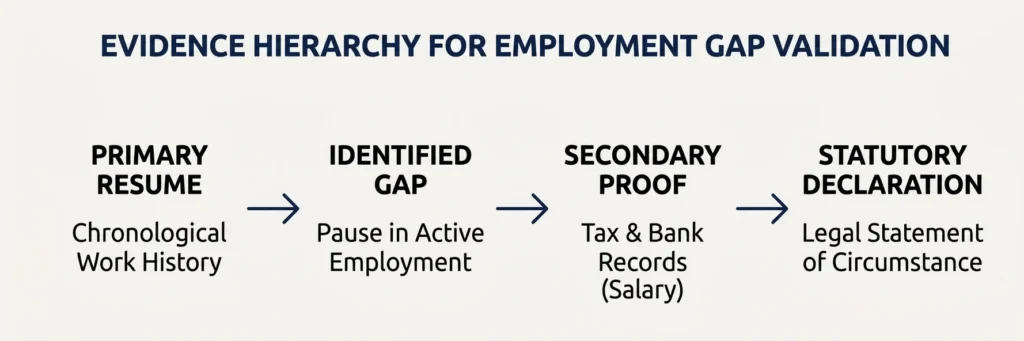
When organising employment timeline evidence, consider the following evidentiary pillars:
-
Employment Records: Review your employment reference letters and other available records for accurate dates, job duties, working hours and payment details, as applicable to your assessment requirements.
- Alternative Employment Evidence: If you cannot obtain a reference letter from a former employer, check the current assessment guidelines to determine whether other official records, such as tax documents or salary records, may be accepted.
- Statutory Declarations: A statutory declaration may help explain missing documents or particular circumstances, where permitted. Check whether additional evidence is required rather than assuming a declaration alone will meet the assessment requirements.
Strategic Steps to Draft Your Employment Gap Explanation
A clear VETASSESS employment gap explanation begins with an accurate timeline and a straightforward account of each relevant break. The following steps can help you organise your employment history and prepare an explanation that is consistent with your supporting documents.
Step 1: Create an Employment Timeline for Your Skills Assessment
Before drafting your statement, organize all months from the time of your graduation until the current date. Include all jobs, studies, and breaks. Make sure there are no overlapping dates or mysterious floating weeks.
Step 2: Write a Clear and Factual Employment Gap Explanation
Do not use any emotionally charged expressions or explanations. Simply write down the dates, the cause for the change, and what you did in the gap.
Step 3: Check Your Work Experience Against the Relevant Occupation Criteria
Check the relevant occupation and assessment requirements for the accepted employment period, working hours, and skill level. Do not assume that a single working-hours threshold applies to every occupation or assessment pathway.
How ImmiDocs Can Help With Your VETASSESS Employment Gap Explanation
Preparing a VETASSESS employment gap explanation can involve organising employment records, reviewing dates and identifying documents that may help clarify your work history. ImmiDocs provides document preparation support for applicants who need help organising their skills assessment paperwork.
At Immidocs, we specialize in comprehensive VETASSESS skills assessment preparation, document curation, and visa application support. Our expert team assists professionals across diverse sectors by providing:
- Detailed Work History Audits: We examine your chronological background, identify vulnerable employment gaps, and help bridge them with appropriate secondary evidence.
- Statement of Service & Reference Letter Writing Support: Crafting precise, compliant employment letters that directly satisfy assessing authority guidelines.
- Statutory Declaration Drafting: Writing clear, legally sound statutory declarations to account for missing documentation or non-standard career breaks.
- End-to-End Migration Documentation: From initial ANZSCO code selection and qualification translation support to final visa lodgement assistance, Immidocs ensures absolute accuracy, transparency, and peace of mind.
Common Mistakes to Avoid When Explaining Employment Gaps
When preparing a skills assessment application, review your employment gaps and make sure your timeline does not conflict with the dates in your supporting documents.
- Leaving unexplained gaps in your chronology: Examine your employment history and clarify important gaps where necessary.
- Providing inaccurate dates: Make sure that all dates in your CV, employment history statement and application form correspond to official documents.
- Presenting working experience in the period of a career break: Present employment periods correctly, instead of trying to cover the gap with fictitious employment periods.
- Using only a statutory declaration: In the case of professional occupations assessed by VETASSESS, a declaration cannot replace official documents confirming employment dates and salaries.
- Providing incomplete employment documents: Check what kind of information about employment is required according to the criteria: period of employment, responsibilities, working hours, and payment confirmation.
- Explaining too much personal information: Provide sufficient information about the reasons for the gap in your employment but do not mention unnecessary personal information.
- Thinking that a gap in your employment is an automatic failure: It doesn’t prove either compliance or non-compliance with the criteria. This depends on the specific criteria and documents that are available.
Conclusion
The existence of any employment gap will not necessarily mean that you will not get a positive skills assessment result. What counts is to be aware of what is needed for your nominated occupation and to provide correct information about your employment experience with proper evidence.
First, you should prepare a chronological employment schedule, find out employment gaps and see if your paperwork proves the claimed employment. In case there is no proper paperwork, it might be a good idea to seek other official proof and read the current VETASSESS guidelines for your assessment process.
In case you need any assistance with organizing your employment paperwork and making a proper explanation of your work experience, ImmiDocs can provide you with the necessary skills assessment paperwork.
Frequently Asked Questions
Do Employment Gaps Affect a VETASSESS Skills Assessment?
Not necessarily; however, your total eligible work experience should be sufficient to fulfill the minimum requirements for your chosen occupation.
How do I explain work experience gaps in my application?
Mention the time period and the cause of interruption briefly and provide some proof, and make sure that the dates correspond exactly with the dates in your CV.
What Documents Can Support a VETASSESS Employment Gap Explanation?
You can provide transcripts of your studies, a medical certificate, leave of absence proof, a letter about redundancy or even the fact that you were on sick leave and didn’t work for certain periods of time, supported by the absence of reference letters.
Can a statutory declaration serve as proof of employment gap for VETASSESS?
The statutory declaration gives you some useful information; however, for professionals, a statutory declaration cannot be used solely to prove employment dates and salary level. You still need some official documents to support your claims.
Does VETASSESS consider pre- and post-career break employment?
Yes, a career break doesn’t mean that your pre- and post-career experience doesn’t count as eligible and skills-based work experience.