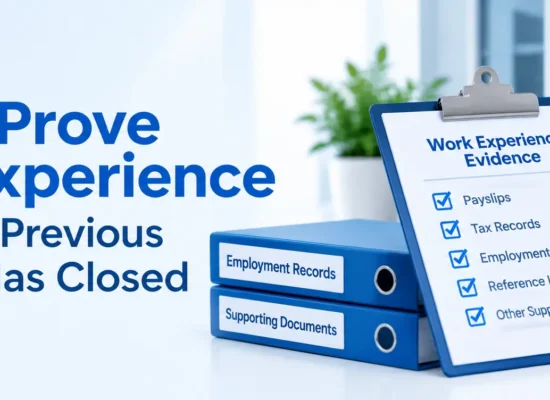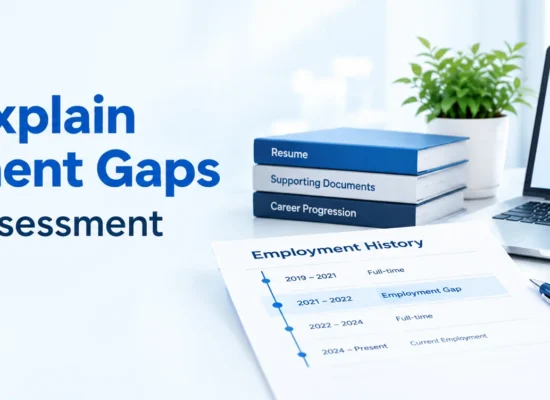
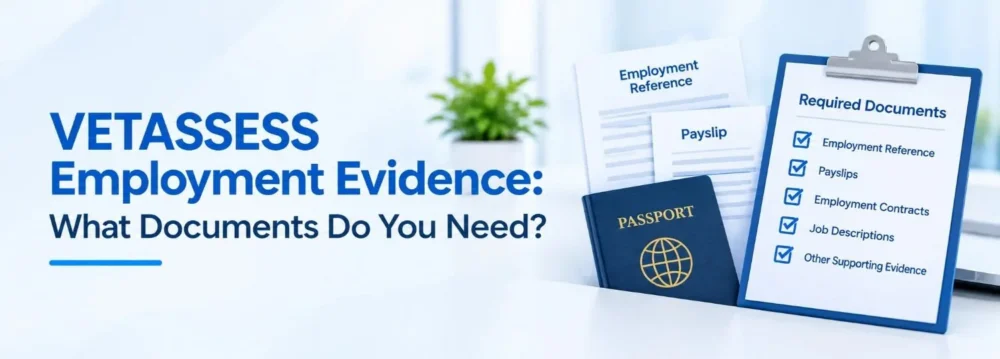
The collection of correct documentation for the assessment is an essential component of the VETASSESS skills assessment process. You need to prove that you have real work experience, which is paid and related to the chosen occupation. Otherwise, the lack of data and incomplete reference letters will make the assessment process quite difficult for you.
Knowing the VETASSESS employment evidence requirements before the assessment will assist you to arrange the required documentation and save your time.
Whether you are a full-time employee, a part-time employee, or you are self-employed, you are expected to present your employment evidence in the proper way. This guide provides details about the required documentation and how to prepare your proof of employment for VETASSESS, and which additional records may support your application.
What Is VETASSESS Employment Evidence?
Vetasass employment evidence is generally the official documents that one would present to demonstrate his or her past employment record, duties performed in the job, number of hours worked in the job, and your wage.
These documents will help the assessors determine whether you have enough experience in your chosen occupation.
In general, employment evidence should prove three very important issues:
- Employment record: Where you worked and what you were doing in your job.
- Duties performed: Duties and responsibilities which you had to perform while working.
- Payment for work: Whether or not you received payment for the work performed by you.
Depending upon your occupation, your pathway of assessment, and the nature of employment, the exact VETASSESS employment evidence requirements will be different.
What Documents Are Required for a VETASSESS Skills Assessment?
The applicant is normally required to have a combination of official employment and financial documents. Further evidence might be needed based on the job. The following are the key documents used as proof of employment for VETASSESS.
1. Statement of Service / Employment Reference Letter
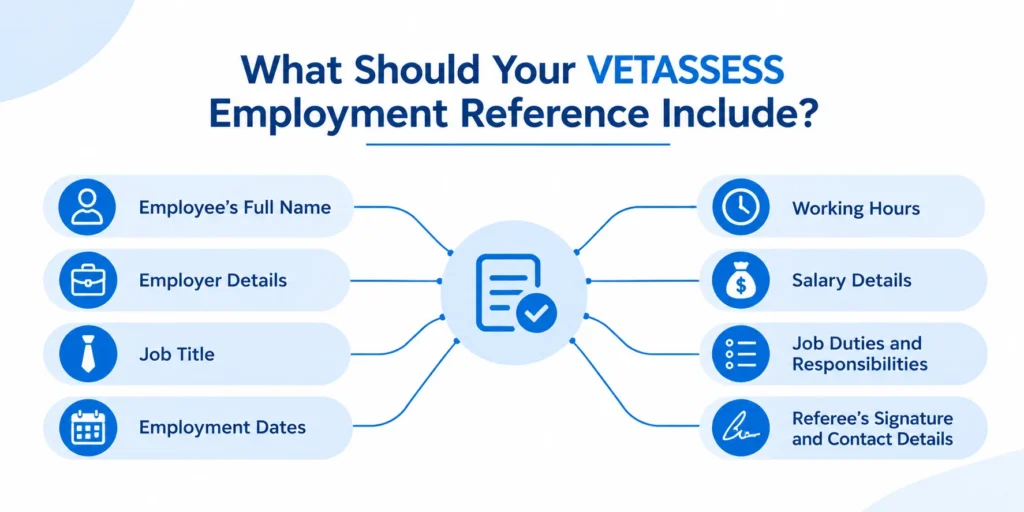
A Statement of Service is one of the most important documents when providing proof of employment for VETASSESS.
An illustration would be stating that “responsible for managing projects.” This gives insufficient details, and a better description is “responsible for the management of X type of projects involving certain activities.”
Note: The reference must be based on your actual work experience, and your job title does not automatically qualify your employment in relation to your nominated occupation.
2. Payslips
Payslips can be produced to prove that the employment under which you claim is paid employment.
It should state your identity as an employee and that of the employer. Depending on the VETASSESS employment evidence requirements, you will be asked to provide several payslips that cover the claimed employment period.
In case of a professional occupation, VETASSESS will accept at least two payslips to be produced as payment proof. The instructions recommend producing the first and the last payslips if it is possible.
In other cases, the required evidence might vary. For example, according to the evidence guide for trade assessment, three payslips need to be provided for the beginning, middle, and end of each claimed year.
Please check that:
- Your name is clearly indicated.
- The name of the employer is stated.
- The payment dates and amounts can be read clearly.
3. Taxation Documents
The documents of taxation can serve as additional evidence for your employment income. They may help support your proof of employment for VETASSESS, particularly when submitted alongside other employment records.
Depending on your country and the nature of your employment, you should be able to find the following:
- Income declaration statements.
- Summaries of taxes paid.
- Tax group statements.
- Notice of assessment.
- Official income tax declaration documents.
These documents will help to prove the financial aspect of your employment. It is essential to ensure that the documents list your name and if possible, the name of your employer. In case the employment connection is not established with these documents, you may need to provide additional VETASSESS supporting documents.
4. Bank Statements
Bank statements may be used to prove receipt of periodic salary payments from the employer. This is especially helpful in situations where there are no payslips available or when further financial information is required.
To strengthen your supporting documents, your bank statements as proof of employment for VETASSESS
must include:
- Your name as the account holder.
- Name of the employer if provided.
- Salary payments or transaction details.
- Dates and amounts of these transactions.
- Point out your salary payments so as to distinguish them easily.
In case of salary payments from a personal account or under a different name from that of the company, give supporting documentation for clarification, if possible.
5. Superannuation or Pension Records
Superannuation and pension files could also assist in proving the existence of the employment relationship. The records would indicate any contributions that have been made in your name by the employer and would serve to show proof of employment. Depending on the country in question, these records may include:
- Statements of contributions to superannuation schemes by the employer.
- Records of contributions to pension schemes.
- Insurance contributions based on employment.
- Retirement funds statements.
Make sure that the records mention your name as well as the name of the employer or organization making the contributions. These may be useful VETASSESS supporting documents when additional evidence of your employment is needed.
6. Employment Contracts and Appointment Letters
Job offers and appointment letters will give you good background information regarding your job. They may include:
- Job title.
- Date of employment start.
- Remuneration.
- Work schedule.
- Terms of employment.
- Employer’s information.
But then again, these papers do not show the duties that you were really carrying out during your time in employment. For this reason, it is usually advisable to submit them together with the Statement of Service.
What Additional VETASSESS Supporting Documents May Be Required?
In addition to employment references and payment records, there may be other documents required by some applicants to prove their duties in their profession and organisational level of experience or responsibilities. These VETASSESS supporting documents vary according to the occupation and the assessment pathway.
- Position Description: A document that outlines your position and duties within the specific organisation.
- Organisational Chart: A chart reflecting the structure of the organisation and your place in this structure. VETASSESS asks for an organisational chart of your organisation for the following occupations: managerial occupations and professional occupations including Management Consultant, Marketing Specialist, Internal Auditor and Program/Project Administrator.
- List of Projects or Samples of Work: There might be cases where you will need to provide some form of proof of your project, activity, or work done. Depending upon your professional profile, this could include project reports, portfolio samples, research papers, design work, projects done, or professional activity done.
The above documents can prove the practical application of your expertise and knowledge. In case there is a need for client confidentiality, you can redact any confidential data from it, but not at the cost of losing the essence of your work. - Resume or CV: An up-to-date CV shows an overview of your education, employment profile, professional experience, and related skills. Your CV must be consistent with the data that has been mentioned in your employment reference letters and other supporting documents.
What Employment Evidence Is Required for Self-Employed Applicants?
People in self-employment do not have regular proof of work experience in the form of letters from the employer or payslips. However, they must submit sufficient evidence of their business, responsibilities, and income.
However, they still need to provide sufficient evidence of their business activities, professional responsibilities and income. Preparing suitable VETASSESS employment evidence for self-employed applicants is important for demonstrating the nature and period of their work.
Depending on the profession, the following documents may be helpful:
- Documents on business registration: You must submit the documents showing registration and operation of the business for the period when you were self-employed.
- Statement by the Registered Accountant / Legal Practitioner: A statement by the registered/qualified accountant/legal practitioner may confirm your self-employment period and other necessary details.
- Statutory Declaration: People doing self-employment may not have work experience that includes letters from the employer or payslips. However, they must submit enough evidence of their business activities, professional responsibilities, and income.
Nevertheless, the statutory declaration may help in such cases. It may confirm your main responsibilities and other information about self-employment. However, it cannot replace the necessary official evidence of your self-employment periods and payment history. - Client Invoices and Bank Statements: The invoices given to clients and bank statements could serve as proof of the revenue earned by the business.
- Client Contracts and Testimonials: Contracts from clients, their testimonials, and documentation of work done could provide further proof of the service offered.
What If You Cannot Obtain an Employment Reference Letter?
Not all applicants will manage to get the Statement of Service from their former employer. This could happen because the business has ceased operations, because the employer is not responding anymore, or because the business refuses to give you detailed information on your employment. Here you need to provide as much other official documentation as you possibly can.
If you cannot obtain a reference letter, gather as many alternative official employment records as possible. These may help support your proof of employment for VETASSESS.
Depending on your circumstances, alternative documents may include:
- Your employment contract.
- Letters regarding your appointment and promotion.
- Your payslips.
- Taxation information.
- Your bank statements which confirm your salary payments.
- An official position description.
- Other records provided by the employer regarding your employment.
The statutory declaration could also serve as an explanation for the absence of particular documents or as additional information on your employment responsibilities. It is necessary to know that a statutory declaration alone is not enough. VETASSESS requires you to submit some other official documentation, especially regarding dates and payment.
If your employer no longer operates, you should try to gather other historical employment and financial documents.
Common Mistakes to Avoid When Preparing VETASSESS Employment Evidence
Even when applicants have several years of work experience, incomplete documentation can create problems during the assessment process. Here are some common mistakes to avoid when preparing your VETASSESS employment evidence:
- Submitting Incomplete Reference Letters: Missing employment dates, working hours, salary details or referee information can make it difficult to verify your employment.
- Providing General Job Responsibilities: Descriptions that do not explain your actual duties may fail to demonstrate the relevance of your work experience.
- Not Providing Payment Evidence: An employment reference letter confirms what an employer states about your work, but financial records help establish that the employment was paid.
- Inconsistent Employment Details: Differences in job titles, dates or employer information across documents may require further clarification.
- Ignoring Occupation-Specific Requirements: Some occupations require additional VETASSESS supporting documents, such as organisational charts, project lists or portfolios. Submitting only general employment records may leave important requirements unmet.
- Uploading Poor-Quality Documents: Blurry scans, cropped information and unreadable financial records can make document verification difficult. Review all documents before uploading them.
How to Prepare Your VETASSESS Employment Evidence
Having all of your documentation organised prior to making an application will make the process much easier. Here’s how to prepare your VETASSESS employment evidence.
Step 1: Analyse Your Occupational Requirements
Review the VETASSESS occupational requirements of your nominated occupation and pathway and identify what evidence is needed.
Step 2: Obtain Employment Records
Obtain Statements of Service, contract documents or any other evidence from your current and former employers.
Step 3: Provide Payment Evidence
Gather any evidence such as payslips, taxation documents, bank statements or superannuation documents showing that you were paid for your employment.
Step 4: Verify your Employment Information
Verify that there are no contradictions regarding your dates of employment, positions held, hours worked, or employing organization between your evidence.
Step 5: Obtain Additional Supporting Documents
Prepare organizational charts, project evidence, portfolios, and any other occupation-specific evidence.
Step 6: Review and Organize your Documents
Make sure your documents are clear and ready to be uploaded
Frequently Asked Questions
- Can I apply without a Statement of Service?
Applicants can submit other forms of official employment records and even a statutory declaration where necessary. Nevertheless, the statutory declaration cannot prove all elements of employment. - Is it possible to use bank statements as proof of employment?
Yes. It is possible to use bank statements that contain your identifiable salary payments, your name, and the name of the employer. - What documents should I submit as a self-employed applicant?
Documents for self-employed people can include registration documents for the business, statements from the accountant/legal practitioners, statutory declaration, clients’ invoices, bank statements and clients’ contracts. - Should VETASSESS employment documents be certified?
In general, the VETASSESS organization does not require any certification of high-quality scanned original documents. Check application instructions relevant to your assessment pathway. - Is it required to translate employment documents into English?
Yes. Documents issued in a foreign language should be submitted along with an English.