

Getting a decision about your skills assessment from VETASSESS is perhaps the most important moment on your path to Australian migration.
Nonetheless, receiving an email or downloading a document with the results is only half of your application journey. What happens next will make a difference in whether you will easily get ahead with your visa application or will lose vital points, time, and money.
Whether you receive a VETASSESS positive outcome letter, an interim Request for Further Information (RFI), or a VETASSESS negative outcome letter, this 2026 guide covers the complete explanation of what a VETASSESS outcome letter really means, tells you how to interpret all the details of your VETASSESS outcome letter, and provides the precise steps you need to follow to deal with any situation including the VETASSESS outcome letter review or appeal.
Major Key Highlights
- Strategic Action Depends on Outcome: If the decision is positive, you need to ensure your “Date Deemed Skilled” before submitting an EOI through SkillSelect, but in case of a negative decision, then stringent review periods (such as 90 days for reviews and appeals) apply.
- “Date Deemed Skilled” Is Vital for Migration Points: In case of positive decision outcomes, you need to understand that only post-skilled-date employment experiences will count towards migration points through GSM subclasses 189, 190, and 491.
- Negative Outcomes Are Not Final Decisions: A negative decision from a VETASSESS assessment does not mean you have lost everything as the choice of whether to pursue a Formal Review (in case of assessors’ error) or Reassessment (submission of new evidence) may convert it into a VETASSESS positive decision letter.
What Is a VETASSESS Outcome Letter?
A VETASSESS outcome letter is the letter officially provided to you by VETASSESS after evaluating your education and professional experience as per ANZSCO (Australian and New Zealand Standard Classification of Occupations) guidelines.
For more than 300 professional and general occupations, including Marketing Specialists, Financial Investment Advisors, and Construction Project Managers, among many others, this letter serves as proof of your eligibility as a professional according to Australian standards.
Key Components of Your Assessment Result
When reviewing your VETASSESS outcome letter sample or official digital decision document, pay strict attention to three core fields:
- Evaluated Qualifications: States whether your tertiary degrees or diplomas are assessed as comparable to the Australian Qualifications Framework (AQF) level required for your nominated occupation.
- Assessed Employment: Details which specific employment episodes were deemed “closely related” and highly relevant to your ANZSCO code.
- Skilled Date (Date Deemed Skilled): The official date from which VETASSESS considers you fully qualified in your occupation. Work completed before this date qualifies you for the role but cannot be claimed for skilled migration points on your visa application.
Comparing Outcome Types: Positive vs. Negative Outcomes
Understanding the exact VETASSESS outcome letter meaning helps you determine where your application stands the moment your decision is issued.
| Aspect | VETASSESS Positive Outcome Letter | VETASSESS Negative Outcome Letter |
|---|---|---|
| Primary Meaning | Qualifications and work history meet Australian standards for the nominated ANZSCO occupation. | Submitted evidence was deemed insufficient, unverified, or non-compliant with ANZSCO standards. |
| Migration Impact | Can be submitted immediately to DHA for Expression of Interest (EOI) and state nomination processing. | Cannot be used to claim skilled migration points for the nominated occupation. |
| Date Deemed Skilled | Explicitly lists a “Skilled Date” from which migration points can be accumulated. | No skilled date is provided due to an unsuccessful outcome. |
| Validity Period | Valid for 3 years from the date of issue for Australian immigration purposes. | N/A (Requires formal dispute or new application). |
| Next Action Steps | Lodge EOI in SkillSelect, seek state/territory nomination, or prepare visa application. | Lodge a VETASSESS outcome letter review, apply for Reassessment, or file an Appeal. |
How to Respond to a Positive VETASSESS Outcome Letter
Receiving a VETASSESS positive outcome letter is a major success, but simply holding the letter is not enough. You must strategically execute the following post-assessment actions:
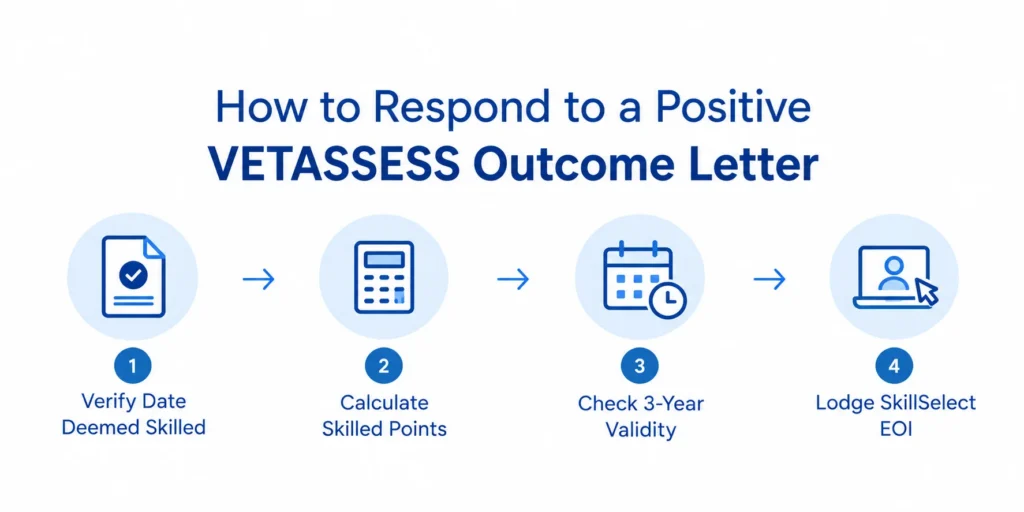
Step 1: Check Your “Date Deemed Skilled”
Take note of the specific month and year listed as your date deemed skilled. If you have accumulated five years of experience and VETASSESS subtracts two years to meet the requirements of entry for your ANZSCO occupation, your “Date Deemed Skilled” would be year three.
You should calculate the points based on just three years’ worth of employment experience when completing your visa application. Taking into account any work done before this date will lead to a visa refusal by Home Affairs due to the over-claiming of points.
Step 2: Review Your Expired Dates
Your positive outcome letter issued by VETASSESS expires after 3 years. You should ensure that your Expression of Interest (EOI) and nomination invitations are completed within these 3 years. If your positive outcome letter is close to expiry, you should apply for a renewal of skills assessment before applying for your visa.
Step 3: Lodge Your Expression of Interest (EOI)
Go to the Department of Home Affairs SkillSelect website. Input your VETASSESS unique reference number, nominate your ANZSCO occupation code, and enter your verified employment history corresponding to the dates accepted on your VETASSESS assessment result.
Step 4: Submit a State or Territory Nomination Application
If your pathway relies on a Skilled Nominated visa (Subclass 190) or Skilled Work Regional visa (Subclass 491), submit your Registration of Interest (ROI) or state application to your chosen Australian state, attaching your positive outcome document.
How to Respond to an Interim Request for Further Information (RFI)
Prior to a final VETASSESS assessment outcome being determined, the assessor can issue an interim request or Request for Further Information (RFI). RFI is a chance for the applicant to save their case from a final negative outcome.
Common RFI Triggers & Corrective Actions
- Generic Statements of Duties: If your employer reference letter was copied exactly from the ANZSCO duties description, then the assessor would ask for detailed task statements to be provided. Answer this by providing an updated Statement of Service that specifies individual projects, equipment, and daily activities performed.
- Missing Payment Documents: The VETASSESS integrity team checks employment information submitted by candidates with corresponding payment documents. Provide the government assessment of tax payments, bank statement showing salary payments, or pension documents.
- Signatories Not Contactable: In case the VETASSESS integrity team cannot reach your line manager, provide another means to contact your supervisor, organization structure chart, or any other manager’s contact information.
How to Respond to a Negative VETASSESS Outcome Letter
It is discouraging to open a letter from VETASSES negative outcome letter, but this does not mean that your Australian migration process is finished. There are formal ways in which you can contest or appeal a negative assessment at VETASSESS.
Step 1: Identify the Reasons behind the Decision
Go to your online portal account and download the full decision reasons. VETASSESS clearly states the reasons why the application was assessed as unsuitable. They fall into two possible categories:
- Not a Suitable Qualification: This means that either the educational qualification did not meet the equivalent AQF requirement, or the major field of study was not relevant enough to the ANZSCO occupation.
- Not a Suitable Employment Experience: It is based on the following criteria: the duties required seniority, fewer than 20 paid hours per week, payment cannot be verified, or the tasks do not meet the 80% ANZSCO criteria.
Step 2: Decide on Your Option to Appeal
There are three different administrative routes to pursue when appealing or reassessing a result:
Option A: VETASSESS Outcome Letter Review Application
The VETASSESS outcome letter review application applies to cases when you think that the original assessor misunderstood the provided information or there was an administrative error.
- Deadline: Should be received no later than 90 days after the initial outcome.
- Process: A different and independent senior assessor will review your application.
- Documents: You can provide some minor additional clarifications or even submit a formal statement explaining where the initial assessment went wrong.
Option B: Submitting a Reassessment Request
If you were refused because of a lack of the necessary documents (for instance, no tax documents, unformatted reference letters, missing job titles), the appropriate path to take would be Reassessment.
Timeline: Should be submitted within 12 months of receipt of the initial outcome letter.
Process: Enables you to provide additional evidence, revised Statements of Services, or even completely switch your chosen ANZSCO occupation code.
Option C: Submitting a Formal Appeal
If your VETASSESS outcome letter review turns out to be negative and you feel that there have been any violations of the policies during the assessment procedure, you can submit a Formal Appeal.
Timeline: Should be submitted within 90 days of receipt of the Review decision.
Process: Includes a review of the assessment by an independent committee of experts.
Summary of Post-Outcome Options & Deadlines
To ensure you never miss a critical migration deadline, use this reference table when planning your response to a VETASSESS assessment outcome:
| Response Mechanism | Eligibility Window | Primary Purpose | Allowed Evidence |
|---|---|---|---|
| Formal Review | Within 90 calendar days | Dispute an assessor error or misinterpretation. | Original documents plus minor written clarifications. |
| Reassessment | Within 12 months | Submit new experience or change nominated ANZSCO occupation. | Substantial new documentation, pay slips, and revised references. |
| Formal Appeal | Within 90 calendar days of the review outcome | Final contest of assessment procedural fairness. | Reviewed file evidence examined by independent panel. |
| Renewal | Within 3 years of positive outcome | Extend expiring positive assessment for visa lodgement. | Updated employment details since original assessment. |
Ready to Fast-Track Your VETASSESS Assessment?
Take the first step toward securing your positive outcome with total confidence! Contact our experts today to access professional skills assessment preparation services and accelerate your journey to Australia.
Frequently Asked Questions (FAQs)
What is the validity period of a VETASSESS outcome letter?
A positive VETASSESS outcome letter is valid for 3 years from its issue date for Australian migration purposes.
How can I overturn a negative VETASSESS outcome?
You can overturn an adverse result by requesting a Formal Review within 90 days or by submitting a Reassessment within 12 months
Why does VETASSESS issue a Request for Further Information (RFI)?
VETASSESS issues an RFI when your application lacks required proof, such as generic job duties, unverified supervisor contacts, or missing pay slips.
What is the difference between a Review and a Reassessment?
Formal Review checks whether any mistakes have been made in assessing the existing documents, whereas a Reassessment enables you to provide new information, add more employment experience, or change the ANZSCO code.
Why is the “Date Deemed Skilled” important on a positive letter?
The “Date Deemed Skilled” marks the exact point you met the minimum qualification and work experience requirements for your ANZSCO group. You can only claim skilled migration points for work experience accumulated after this date.
What should I do if my employer refuses to provide a detailed reference letter?
Submit a signed Statutory Declaration or Affidavit detailing your daily tasks, paired with official secondary evidence .
How long does a VETASSESS outcome review take?
A standard Review takes approximately 7 to 8 weeks. Formal Appeals generally take up to 12 weeks, depending on case complexity.
Does a negative VETASSESS outcome affect my visa history with Home Affairs?
No. A negative skills assessment is an administrative decision by VETASSESS, not a visa refusal.