Why Your VETASSESS Reference Letter Can Make or Break Your Visa Journey
Securing a positive skills assessment from VETASSESS (Vocational Education and Assessment Services) is a crucial stepping stone toward migrating to Australia as a skilled professional. Whether you are applying under General Professional Occupations or Trade Occupations, proving your work history requires much more than a standard resume or a brief service certificate.
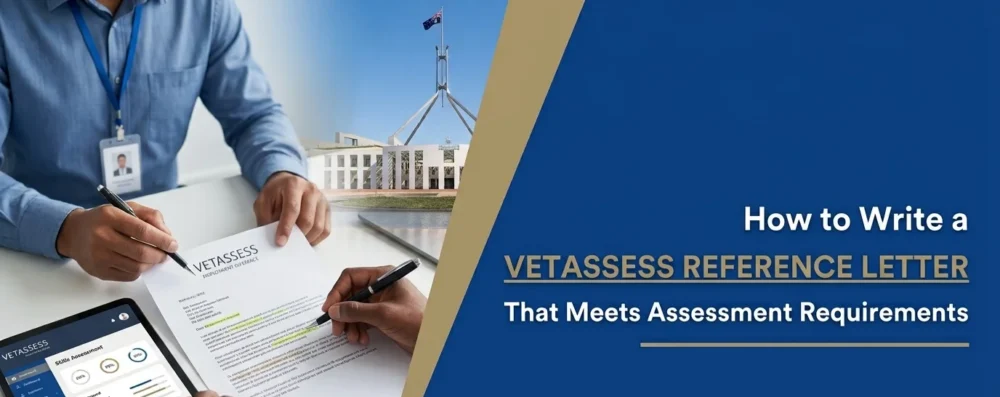
The centerpiece of your employment evidence is a comprehensive VETASSESS reference letter. Unlike a generic recommendation letter written for a job application, a VETASSESS employment reference letter is a formal, highly specific legal document designed to verify your job title, employment duration, salary, and most importantly, the precise duties you performed every day.
A minor omission, such as forgetting to mention whether your role was full-time or omitting your manager’s direct contact details, can result in delays, requests for further information (RFIs), or even a negative assessment outcome.
In this complete 2026 guide, we will break down the essential VETASSESS reference letter requirements, provide an easy-to-follow structure, highlight common pitfalls to avoid, and show you how to streamline your application using ImmiDocs VETASSESS Skills Assessment Preparation Services.
Major Key Highlights
- Critical for Skill Assessment: The VETASSESS reference letter is one of the most vital supporting documents in your application; it directly proves whether your paid work experience aligns with Australian standards.
- Strict Format Rules: Missing key details like official company letterhead, specific employment dates, exact weekly hours, or detailed task descriptions often lead to unnecessary delays or outright rejections.
- ANZSCO Code Alignment: Your VETASSESS reference letter format must clearly map your daily duties to the official ANZSCO occupation guidelines, showing that you performed tasks at the required skill level.
- Updated 2026 Standards: VETASSESS continues to increase scrutiny on third-party verification, pay slips, tax documents, and structural consistency across all employment reference letters.
- Professional Assistance Matters: Using specialized support like ImmiDocs VETASSESS Skills Assessment Preparation Services ensures your documents are fully compliant before submission, saving time and money.
Essential VETASSESS Reference Letter Requirements in 2026
To pass assessment scrutiny, your VETASSESS reference letter must comply with strict structural and evidentiary standards set by VETASSESS. Understanding these criteria beforehand prevents costly mistakes and speeds up processing times.
Key Criteria Checklist
Every VETASSESS reference letter submitted must satisfy the following core requirements:
1. Official Company Letterhead
The letter must be issued on official company stationery displaying the company name, physical address, phone number, official email address, and website URL.
2. Clear Employer and Author Identity
It must be signed by an authorized representative (e.g., HR Manager, Direct Supervisor, Department Head, or Managing Director). The author’s full name, job title, direct work phone number, and official work email address must be clearly stated.
3. Exact Employment Period
Start and end dates must be provided in a DD/MM/YYYY format. Avoid using general descriptions such as “2020 to present” or “approximately 3 years.”
4. Working Hours and Employment Status
Specify whether the role was Full-Time or Part-Time, along with the exact number of hours worked per week (e.g., 38 hours/week). VETASSESS generally requires a minimum of 20 hours per week for work to be considered toward skilled employment.
5. Official Job Titles
List your exact official designations. If you held multiple roles within the same organization, break down each position with its respective start and end dates.
6. Detailed List of Main Duties
Provide 5 to 10 detailed bullet points describing your core responsibilities. These duties must align closely with the ANZSCO (Australian and New Zealand Standard Classification of Occupations) description for your nominated occupation.
7. Salary and Remuneration Details
State your annual salary, hourly rate, or overall pay structure. Remuneration serves as tangible evidence that your role was paid and engaged at a professional skill level.
Standard VETASSESS Reference Letter Format
Following a structured VETASSESS reference letter format ensures assessors can quickly verify every mandatory detail without confusion. Below is a breakdown of the standard structure you should follow.
| Section | Required Details | Purpose for VETASSESS |
|---|---|---|
| Header | Company Logo, Address, Contact Info, Date | Validates company identity and legitimacy. |
| Addressee | “To VETASSESS Skills Assessment Division” | Formally directs the document to the assessing authority. |
| Employee Details | Full Legal Name, Official Job Title, Working Hours | Establishes the identity and capacity of the applicant. |
| Employment Period | Exact Start & End Dates (DD/MM/YYYY) | Calculates total months/years of skilled employment. |
| Core Responsibilities | 5–10 specific, detailed duty statements | Maps work experience against ANZSCO occupation descriptors. |
| Salary & Terms | Base Pay, Allowances, Full-Time/Part-Time status | Confirms genuine paid employment at a professional level. |
| Sign-off Block | Manager/HR Name, Designation, Direct Phone & Email | Provides verification channels for VETASSESS integrity checks. |
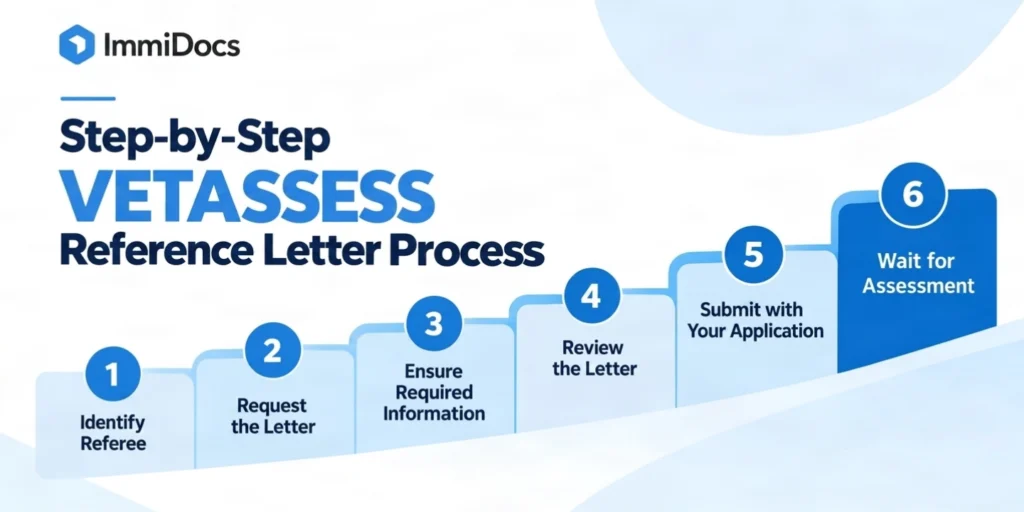
How to Align Your Job Duties with ANZSCO Guidelines
The single most critical element of a VETASSESS reference letter is the duty list. VETASSESS assessors compare your listed responsibilities against the official ANZSCO benchmark for your nominated occupation.
How to Match Duties Effectively
Step 1: Research Your ANZSCO Code
Visit the official VETASSESS website or the Australian Bureau of Statistics (ABS) database to review the official task list for your nominated occupation.
Step 2: Avoid Direct Copy-Pasting
Never copy ANZSCO task descriptions word-for-word. Assessors instantly recognize copied text and may flag your application for fraudulent or non-genuine documentation.
Step 3: Use Action-Oriented Language
Describe what you actually did using strong verbs. Explain how you performed tasks, what tools or methodologies you used, and the outcomes of your work.
Step 4: Focus on Depth and Complexity
Ensure your duties reflect the expected skill level. For instance, if you are applying for a managerial ANZSCO code, your duties must emphasize strategy, team leadership, budget control, and reporting rather than purely operational or entry-level tasks.
Common Pitfalls That Lead to Assessment Delays or Rejections
Thousands of skilled migration applicants face unexpected delays or negative skills assessments every year due to preventable errors in their employment documentation. Pay close attention to these frequent mistakes:
1. Generic Job Descriptions
A brief reference letter stating that you were a “Marketing Specialist responsible for marketing duties” provides zero value to an assessor. Be specific about campaigns, analytics tools, channels, and reporting structures.
2. Missing Contact Information for Verification
VETASSESS frequently conducts random verification calls or email audits. If your supervisor’s contact details are invalid or unreachable, your assessment may be placed on hold or refused.
3. Inconsistencies Across Documents
Your VETASSESS reference letter must perfectly match your pay slips, tax statements, bank statements, resume, and official employment contracts. Discrepancies in job titles, start dates, or salary figures raise immediate red flags.
4. Unsigned or Unstamped Letters
Letters lacking an authentic physical or verified digital signature, or those missing an official company stamp/seal, are frequently rejected as unverified.
5. Self-Employed or Closed Company Complications
If your employer has ceased trading or if you are self-employed, standard reference letters are difficult to obtain. Specific statutory declarations, client references, tax filings, and business registration records are required in these scenarios.
How ImmiDocs Ensures Your VETASSESS Success
Navigating VETASSESS reference letter requirements on your own can feel overwhelming, especially when a single mistake can impact your Australian visa plans. That’s where ImmiDocs VETASSESS Skills Assessment Preparation Services can make all the difference.
Why Choose ImmiDocs?
- Tailored Document Drafting: We help you draft, review, and refine your VETASSESS employment reference letter to ensure complete alignment with ANZSCO standards without triggering plagiarism flags.
- In-Depth Document Auditing: Our team cross-checks your reference letters against your pay slips, tax records, and CV to ensure 100% structural consistency.
- Complex Case Handling: Whether you are self-employed, working for a closed company, or facing difficulty getting HR cooperation, ImmiDocs provides expert guidance on alternative documentation and statutory declarations.
- Fast-Track Confidence: By getting your paperwork right the first time, you avoid costly assessment rejections and speed up your path to Australian permanent residency.
Explore how we can help optimize your application by visiting ImmiDocs today.
Conclusion: Take the First Step Toward Your Australian Visa Today
Writing an accurate, compliant, and ANZSCO-aligned VETASSESS reference letter is one of the single most essential investments you can make in your Australian migration journey. By ensuring your documents meet every specific requirement, from company letterheads to precise duty statements, you significantly increase your chances of obtaining a positive skills assessment on your first attempt.
Don’t leave your visa outcome to chance. Let the migration documentation experts at ImmiDocs guide you through every step of the preparation process. From initial document audits to custom reference letter drafting, our team ensures your application is bulletproof.
Frequently Asked Questions (FAQs)
1. What if my employer won’t give a detailed reference letter?
Submit a Statutory Declaration/Affidavit plus a colleague’s reference and supporting docs (contracts, pay slips, promotion letters).
2. Can I draft the letter myself and have my manager sign it?
Yes. Draft it to cover all ANZSCO duties, then have your employer review and sign it.
3. Does VETASSESS contact my employer?
Yes, often by phone or email. Make sure your referee can be reached and can confirm your role.
4. What is the minimum hours per week to count as skilled employment?
20 hours/week. Anything less usually doesn’t count.
5. Do I need pay slips too?
Yes. A reference letter alone isn’t enough; include pay slips, bank statements, or tax records as proof.
6. Can I copy duties from the ANZSCO website?
No. This can flag your application as non-genuine. Write duties in your own words based on actual work.
7. What if the company has closed down?
Provide proof of closure, a statutory declaration about your role, and secondary evidence (contracts, tax records, colleague references).
8. How far back should my VETASSESS reference letters go?
VETASSESS typically assesses employment experience within the last 10 years. Focus on obtaining detailed, fully compliant reference letters for all relevant roles held during this timeframe.