
The Australian skilled migration program is still evolving in 2026 because the Federal Government has changed key visa parameters to better match migration to economic needs, labor market requirements, and national infrastructure.
Since the policy setting is always changing, it would be unwise to apply any migration advice from past years to the present situation. Instead, you need to verify the ANZSCO occupational code, select the right assessing authority, and score the necessary number of points.
Knowledge of the Australia skilled migration changes 2026 is very important to stay in compliance and ensure your application is ready for a decision. This complete guide explains the policy reset, income-indexed threshold, visa fee changes, and many more things about the Australia migration changes 2026.
Key Highlights
- 185,000 Cap (70% Skilled): Australia capped its permanent migration intake at 185,000 places, with 71% allocated to skilled visas to address critical workforce shortages.
- Indexed Salary Thresholds: Employer-sponsored minimum earnings rose, setting the Core Skills Income Threshold (CSIT) at AUD $79,423 and the Specialist Skills Income Threshold (SSIT) at AUD $146,576.
- Higher Visa Fees: Federal Visa Application Charges increased across key General Skilled Migration categories (Subclasses 189, 190, 491, and 186), starting at AUD $6,135–$6,140 for primary applicants.
Australia Skilled Migration in 2026: The Current Landscape
For the 2026–27 financial year, the Australian government’s Migration Program retains its overall ceiling for migration of 185,000 per annum.
The skilled migration program will continue to be at the heart of the strategy, receiving about 70% of visa allocation to fill skill shortages in health care, education, construction, technology, and engineering sectors.
Among the key operational changes identified in 2026 are:
- Increased income threshold levels for both temporary and permanent employment-based visas as per annual indexation.
- Increased Visa Application Charges (VAC) for most skilled migration visa classes.
- Evaluation of proposals for reforming the GSM points test in the future.
- Invitation policies in both federal and state nomination streams.
Key Updates to Australia Skilled Migration Changes 2026
The following updates highlight the core policy resets that affect applicants moving through the system in 2026:
1. Skilled Visa Income Thresholds Increased
Effective 1 July 2026, skilled visa income thresholds increased by 3.8% in accordance with annual statutory indexation rules based on Average Weekly Ordinary Time Earnings.
2026–27 Skilled Visa Salary Thresholds (1 July 2026)
- Core Skills Income Threshold (CSIT): AUD $79,423 (up from AUD $76,515)
- Specialist Skills Threshold (SSIT): AUD $146,717 (up from AUD $141,210)
Impacted Pathways
- Skills in Demand (Subclass 482) Visa: Core Skills stream nominations require a minimum base salary of AUD $79,423. Specialist Skills stream nominations require AUD $146,717.
- Employer Nomination Scheme (Subclass 186) Visa: Direct Entry and transition nominations must meet or exceed the updated CSIT of AUD $79,423.
- Skilled Employer Sponsored Regional (Subclass 494) Visa: Subject to the updated threshold of AUD $79,423.
Why Applicants and Employers Must Use Current Figures
Any nominations put forth from 1 July 2026 onwards, failing to reach the new threshold levels, will be automatically rejected. In addition to the requirement for the income threshold, employers will have to show that the salary being offered is not less than the Annual Market Salary Rate.
2. Updated Visa Fees for Australia Skilled Migration Changes 2026
The Department of Home Affairs indexed Visa Application Charges (VAC) across multiple subclasses starting 1 July 2026. Applicants budgeting for their migration journey must use current government fee schedules rather than older online calculators.
Subclass 189, 190, and 491 Fee Increases for Australia Skilled Migration Changes 2026
Note: Additional applicant fees apply for adult dependants and children under 18. Fees are locked based on the exact lodgement date.
3. Points Test Review for Australia Skilled Migration Changes 2026
One important aspect of changes to skilled visa Australia 2026 is the continuous review of the General Skilled Migration points test.
Government Discussion Paper: In February 2026, the Government of Australia released a discussion paper on the points test.
Main Objective of the Review: The review will determine whether the current points system is able to identify migrants who have the right skills, educational attributes, and experience to address the needs of the labor market and boost productivity.
Important Distinction (Proposal of Review vs. Existing Law): It is extremely important for applicants to understand that any discussion paper and review is not current law until statutory provisions come into force. The current points table is still valid until then.
4. SkillSelect and Invitation Rounds
Under the Department of Home Affairs framework, SkillSelect remains the official portal for submitting an Expression of Interest (EOI) across points-tested visas:
- Skilled Independent (Subclass 189)
- Skilled Nominated (Subclass 190)
- Skilled Work Regional (Subclass 491)
EOI Mechanics Under Australia Skilled Migration Changes 2026
An EOI is basically an expression of your interest in applying for a skilled visa, and it does not mean that you are applying for a visa. It means that you will need an official invitation from SkillSelect or the nominating state/territory before you can make the visa application under Subclass 189, 190, and 491.
Why Making an EOI Application Does Not Mean That You Will Receive an Invitation
An EOI becomes valid once you have achieved at least 65 points, meeting the minimum baseline requirement. However, an invitation process involves competition, since selection is based on the ceiling for occupations, points rankings of candidates, and sector demand.
How Australia Skilled Migration Changes 2026 Impact Applicants
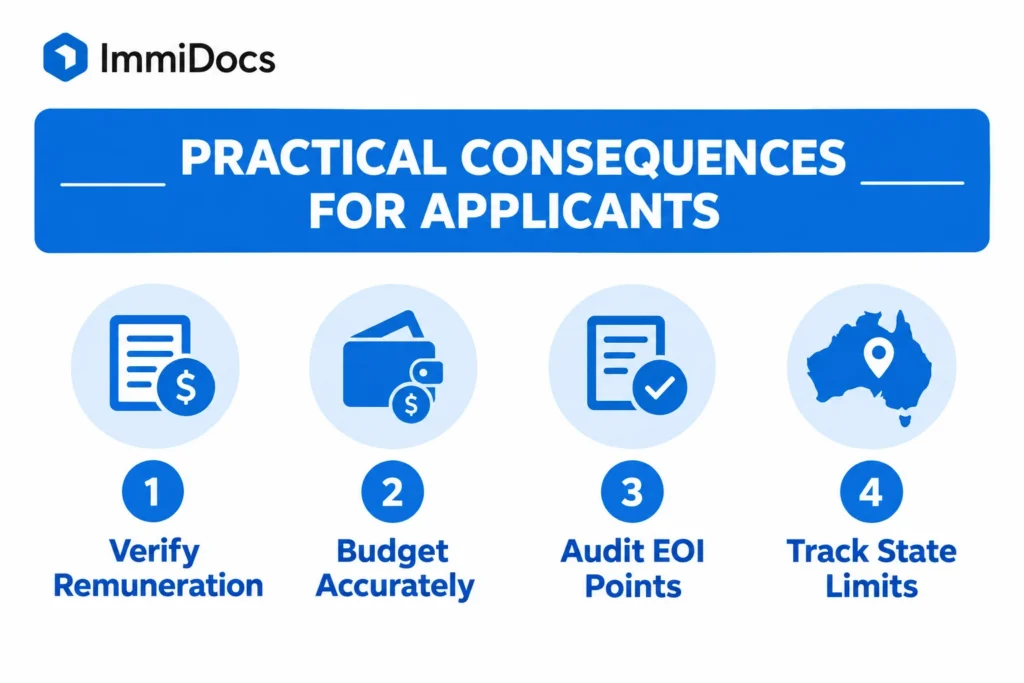
Translating Australia skilled visa updates into practical steps ensures you avoid common pitfalls and maintain a competitive profile:
- Verify Income Compliance: If pursuing employer-sponsored pathways, ensure your proposed employment package satisfies the new AUD $79,423 threshold.
- Adjust Financial Planning: Budget for updated Visa Application Charges and associated costs (medical exams, biometrics, police checks, skills assessment fees).
- Keep EOI Data Current: Update your SkillSelect profile immediately when work experience increases, new English test results are obtained, or marital status changes.
- Monitor State Priority Lists: State nomination seats fill rapidly; track nomination criteria updates on individual state and territory migration portals.
Skills Assessment and Occupation Selection Still Matter
While salary thresholds and points tests feature heavily in skilled migration rules in Australia 2026, securing an accurate Skills Assessment remains the fundamental starting point.
Selecting the Correct Occupation & ANZSCO Code
Each nominated occupation should match a particular 6-digit code in ANZSCO (Australian and New Zealand Standard Classification of Occupations). The choice of an incorrect code may render all previous work experience null and void while undergoing assessment.
Selecting the Correct Assessing Authority
Each occupation group has been allocated a certain assessing authority:
- VETASSESS: Evaluates over 350 professions in the field of professional, management, administrative, and trade occupations.
- ACS (Australian Computer Society): Evaluates ICT occupations.
- Engineers Australia: Evaluates professional engineers and engineering technologists.
- TRA (Trades Recognition Australia): Evaluates licensed trades occupations.
Why Job Title Does Not Matter in This Case
The assessing authority assesses the duties of the applicant’s job, what tasks he performs, and the level of tertiary qualifications in accordance with the ANZSCO standard descriptor. A similar corporate job title cannot be taken into account if employment reference letters do not provide information about tasks prescribed by ANZSCO.
State Nominations Under Australia Skilled Migration Changes 2026
State and territory nomination pathways (Subclass 190 and Subclass 491) offer valuable alternatives to independent migration.
- Subclass 190 Nomination: Grants 5 bonus points toward your GSM total upon state approval.
- Subclass 491 Nomination: Grants 15 bonus points for regional pathways.
- Varying Jurisdictional Rules: Each Australian state and territory (e.g., NSW, Victoria, Queensland, WA) sets independent nomination guidelines, priority occupation lists, and local employment conditions.
- Dynamic Allocations: State nomination allocations are managed separately from Commonwealth direct rounds. Applicants should check current state-specific guidelines rather than assuming federal rules apply uniformly across all regions.
What Has NOT Changed?
Avoid misunderstanding Australia immigration changes 2026 by keeping these foundational facts in mind:
- EOI is NOT a visa application: Making an EOI application does not produce a bridging visa, nor does it provide legal entry to Australia.
- EOI is NOT a guarantee for an invitation: Receiving 65 points qualifies you to participate in SkillSelect, but receiving invitations depends on ranking.
- Passing the Skills Assessment is NOT equivalent to getting a visa: Completing the skills assessment process fulfills just one requirement.
- Reaching the minimum point score is NOT a guarantee of selection: For highly in-demand occupations, invitation scores regularly exceed 85-90 points.
- Eligibility for one occupation on one list does NOT mean eligibility for other visas: An occupation which is eligible under one of the employer-sponsored lists (such as CSOL) does not necessarily qualify for the 189 points-tested round.
2026 Skilled Migration Applicant Checklist
Before lodging your Expression of Interest or visa application, review this step-by-step checklist:
- Right Occupation: The right ANZSCO code has been chosen based on the right tasks performed.
- Skill Assessment: Have received a positive and non-expired Skills Assessment from the authorized assessment body.
- Language Proficiency: Scored enough marks in the IELTS/PTE/OET test within the specified period of time.
- Correct Points Calculation: Calculated points according to the current points table.
- Current Income Level: Ensured that the nomination income offered is at least AUD $79,423 (for Subclass 482/186/494 applications).
- Revised Visa Application Charge: Budgeted for the updated Visa Application Charge (e.g., AUD $6,135-$6,140 for GSM visa application).
- Jurisdiction-Specific Criteria: Considered jurisdiction-specific nomination criteria for Subclass 190 or 491.
- Right EOI: Made sure that all claims made in the SkillSelect are supported by right documents.
- Department of Home Affairs Site: Visited the site of the Department of Home Affairs for updates.
Final Takeaway for Skilled Migration Applicants
Moving through the system of Australian Skilled Migration Changes 2026 means reconciling policy changes with documentation. The salary level has now been indexed to AUD $79,423, fees for applying for a visa have risen, and the points test has been under government review. Nevertheless, the fundamental importance of obtaining a good skills assessment, choosing the proper ANZSCO code, and earning EOI points has not changed.
The best strategy is to consider your eligibility according to official criteria in the moment.
Frequently Asked Questions (FAQs)
1. What is the lowest number of points required for skilled migration to Australia in 2026?
The legal minimum score for an Expression of Interest (EOI) in SkillSelect is 65 points.
2. What is the Core Skills Occupation List (CSOL)?
The CSOL is a list of 456 occupations governing employer-sponsored visas (e.g., Subclass 482 Skills in Demand visa, Subclass 186 Direct Entry stream).
3. Is the English test conducted before 6 August 2025 valid in 2026?
Yes. The tests conducted by 6 August 2025 are valid for up to 3 years from the date of the test, provided there are no special requirements for specific visa subclasses.
4. Is the submission of an EOI a guarantee for getting an invitation to apply for a visa?
No. EOI indicates your interest in SkillSelect, and you can’t apply for the visa until you get the invitation.
5. Is there any possibility that I choose an occupation based on my present job title?
No. Authorities make the assessment on the basis of the duties and qualifications related to the ANZSCO occupations’ core descriptors, not according to the corporate job titles.