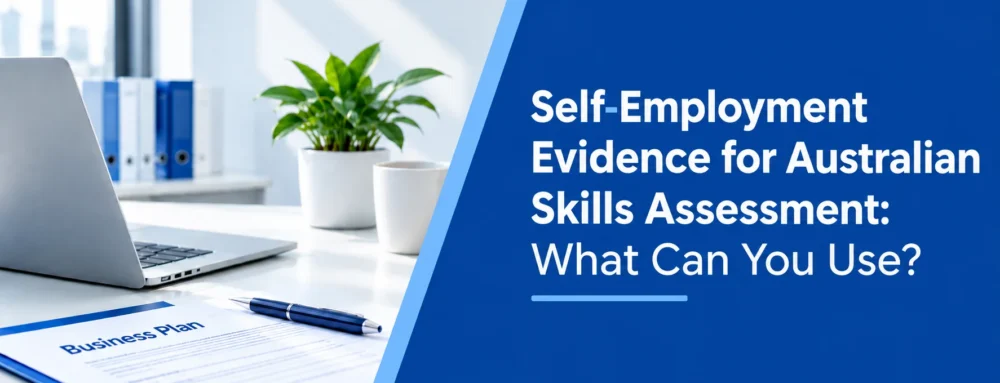
Self-Employment Evidence Skill Assessment (Australia) can be a complex process to navigate, especially for freelancers, independent contractors, and business owners. In contrast to traditional workers, who can have an easier time obtaining regular payslips and an employer reference letter, self-employed individuals will go through a much more stringent Self-Employment evidence skill assessment process by organizations such as VETASSESS, which will analyze your self-employment evidence, trying to ensure the legitimacy of both your business and your daily skilled responsibilities.
Knowing precisely what documents to collect is necessary to prevent any processing delays, additional Request for Information forms, and even the rejection of your application. Below is a thorough guide that will assist you in making sure that your application is rock solid.
Key Highlights
- Proving Self-Employment is Harder Than Pay Stubs: Assessing authorities like VETASSESS require independent, official third-party proof, not just self-issued letters or invoices.
- The Core Requirements: You must provide business registration documents, official tax statements, accountant letters, and client contract proof.
- Payment Evidence is Mandatory: Bank statements showing income from clients or business operations are critical to prove active commercial operations.
- Avoiding RFIs and Refusals: Most delays stem from missing third-party verification, inconsistent dates, or vague job descriptions.
- Professional Assistance Saves Time: Working with document preparation experts ensures your submission aligns perfectly with official migration standards.
Why Is Self-Employment Evidence Skill Assessment So Closely Scrutinized?
Navigating the skilled migration journey to Australia is a transformative milestone. However, if you operate as a freelancer, contractor, or business owner, obtaining a positive skill outcome involves unique challenges.
When claiming skilled employment as an employee, proving your work experience usually requires standard employment reference letters, payslips, and tax records. In contrast, gathering self-employment evidence that skills assessment authorities will accept requires a significantly higher threshold of documentation.
Assessing authorities, most notably VETASSESS, must verify two key elements:
- Business Legitimacy: That your business or independent operation actually existed and operated legally.
- Work Experience & Hours: That you personally performed skilled tasks corresponding to your nominated ANZSCO code for at least 20 hours per week for payment.
Because self-employed applicants generate their own work records, assessing bodies conduct thorough reviews to prevent fraudulent claims. Providing incomplete or unverified documents leads directly to Requests for Information (RFIs), processing delays, or outright refusals.
What Documents Do You Need for a Self-Employment Skill Assessment Australia Application?
To build an unbeatable portfolio, you need to structure your application into four mandatory pillars: Business Identification, Financial Verification, Client & Work Contracts, and Formal Statements.

Pillar 1: Official Business Registration & Legal Documentation
You must prove that your commercial activity was legally registered in your operating jurisdiction throughout the claimed period.
Mandatory Registration Documents
- Business Registration Certificate: Official certificate of incorporation or business name registration issued by a government authority (e.g., ASIC in Australia or equivalent national/state business registers).
- Tax Identification & Licensing: Official proof of tax registration (such as an ABN/ACN confirmation or national tax authority registration).
- Regulatory & Trade Licenses: Any specialized industry licenses or permits required to operate legally in your field (e.g., trade licenses, architectural registrations, or professional memberships).
Pillar 2: Financial & Tax Proof (Earning Real Income)
Assessing bodies must confirm that your self-employment generated continuous income matching market rates. Unpaid work, volunteer roles, or hobby businesses do not qualify.
Acceptable Financial Documents
- Official Tax Returns: Personal and business tax assessment notices issued directly by national tax authorities showing declared income from self-employment.
- Official Bank Statements: Business bank account statements showing regular incoming payments from clients or trade operations.
- Audited Financial Statements: Profit and loss statements and balance sheets signed off by a certified Practicing Accountant (CPA) or Chartered Accountant (CA).
Pillar 3: VETASSESS Self-Employment Evidence Skill Assessment & Statement of Service
A standard employment reference letter won’t suffice when you are your own employer. You must supply a comprehensive Statement of Service on your company letterhead (or a formal Statutory Declaration) detailing your exact responsibilities.
Critical Elements of a Self-Employed Statement of Service
- Official Business Details: Business name, physical address, contact details, and registration numbers.
- Tenure & Hours: Exact start and end dates of operation, along with average working hours per week (must be at least 20 hours/week).
- Detailed Job Description: A comprehensive breakdown of your daily duties, responsibilities, and tools used, mapping directly to your nominated ANZSCO code.
- Formal Verification: Signed and dated by you as the business owner/principal practitioner.
Pillar 4: Self-Employment Documents for Skills Assessment (Client & Project Proof)
You must demonstrate that you actively delivered services to genuine third-party clients during your claimed period.
Supporting Work Portfolio Evidence
- Contracts/Service Agreements: Formal documents detailing project scope, deliverables, timelines, and payment terms.
- Sample Invoices & Receipts: A chronological selection of client invoices corresponding to payments shown in your bank statements.
- Client Reference Letters: Formal letters or emails from major clients confirming the scope of work performed, contract dates, and project completion.
- Project Deliverables & Portfolios: Real-world work samples such as published code, design files, technical reports, or marketing campaign summaries.
Document Checklist: Required vs. Optional Self-Employment Evidence
| Evidence Category | Primary / Mandatory Documents | Secondary / Supporting Documents |
|---|---|---|
| Business Identity | Business Registration Certificate, Tax Registration | Commercial Lease, Website Domain Ownership, Marketing Assets |
| Financial Proof | Tax Returns, CPA Statements, Bank Statements | Invoices, Purchase Orders, Merchant Payment Logs |
| Work Execution | Detailed Statement of Service (ANZSCO aligned) | Client Contracts, Written Client References |
| Qualifications & Standing | Professional Licenses, Degree Certificates | Continuing Professional Development (CPD) Certificates |
Common Pitfalls That Lead to RFIs and Refusals in Your Self-Employment Evidence Skill Assessment (Australia)
Navigating a self-employment evidence skills assessment without professional guidance frequently results in common mistakes:
1. Relying Solely on Personal Affidavits
VETASSESS will reject a statutory declaration you write without independent third-party evidence (such as tax returns or official bank records).
2. Mismatched Financial Transactions
If your declared invoices do not match incoming amounts on your bank statements or tax filings, assessors will question the authenticity of your earnings.
3. Vague Job Descriptions
Copying and pasting ANZSCO tasks word-for-word into your Statement of Service is a major red flag. Your task descriptions must reflect your real-world, day-to-day operations while aligning with ANZSCO requirements.
4. Gaps in Timeline Evidence
Claiming three years of continuous self-employment but only providing invoices for six months creates evidence gaps that can lead to rejected time periods.
Frequently Asked Questions (FAQs)
1. Can I claim self-employment as a sole trader or freelancer?
Yes. Submit official business or tax registration, bank statements showing income, client invoices or contracts, and a detailed Statement of Service aligned with your ANZSCO code.
2. Are cash payments accepted?
No. You must show official third-party financial proof such as bank deposits from clients, official tax assessments, or audited financial records.
4. How many hours per week must I work?
You must prove at least 20 hours per week of paid skilled employment for the entire period claimed.
5. Can I claim experience from a closed business?
Yes. Provide historical business registration, past tax filings, client invoices, bank statements from that period, and proof of formal business closure.
6. Can I combine part-time employment and self-employment?
Yes, as long as both roles align with your nominated ANZSCO code and you provide complete, verifiable documentation meeting the hour requirements for both.
7. Does VETASSESS accept statutory declarations alone?
No. VETASSESS rejects standalone statutory declarations without official third-party proof like tax records, bank deposits, or client references.
8. How many years of financial records do I need?
You must submit official financial evidence (tax returns, bank records, or accountant statements) for every single year of self-employment you wish to claim.