
As Australia to employ the best overseas workers, it has become a top national priority. International professionals from all around the world are looking to explore its flourishing economy, innovative sectors, and high standard of living. Nevertheless, given the current problems associated with labor shortages in the country and the increasing number of older Australians, there has never been a more critical time than now to ensure the recruitment of quality international professionals.
With the aim of ensuring continued economic growth and domestic innovation, the Australian government has introduced special ways through which it can attract quality global talent. This guide aims to review the new methods put in place to enable Australia to employ the best overseas workers, which include the transition of the GTI program into NIV (Subclass 858), the GTES program, the Skilled Occupation List Australia, and Workforce Australia.
Strategic Initiatives for Australia to Employ the Best Overseas Workers
- Global Talent Officers from the Australian Department of Home Affairs have been employed in various innovative centers across the globe. They help identify talent and make presentations about career opportunities in Australia to facilitate their relocation to Australia.
- The recruitment of foreign professionals holds many benefits for the country:
- Filling Skill Gaps: Helps meet the skill gaps in the rapidly growing and innovative industries.
- Innovations: Helps bring global skills, inventions, and innovations to local businesses.
- Job Creation: Knowledge transfer and business growth create job opportunities for domestic citizens.
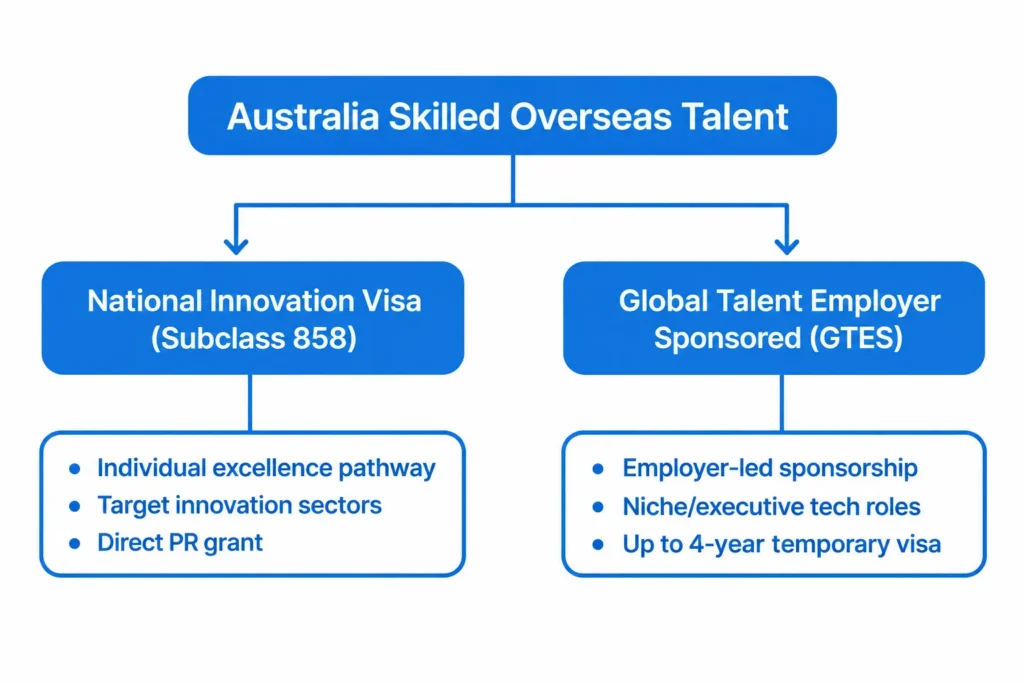
1. Global Talent Independent Program (GTI) / National Innovation Visa (Subclass 858)
The Global Talent Independent Program (GTI) was created for the attraction of international top innovators and highly qualified specialists. The official conversion of the GTI program into the National Innovation Visa (NIV – Subclass 858) took place in December 2024. The new program retains the option of obtaining permanent residence through the Subclass 858 but has more streamlined procedures and priority sectors.
Priority Sectors
The candidate will need to prove outstanding international success in any of the following key sectors of development:
- AgTech (Agri-food and Ag Tech)
- Space and Advanced Manufacturing
- FinTech (Financial Services and FinTech)
- Energy, Resources, and Mining Tech
- MedTech (Medical Technology and Pharmaceuticals)
- Cyber Security
- Quantum Information, Advanced Digital, Data Science, and ICT
Income Earner Threshold
The candidate must prove the capability of earning at or above the Fair Work High Income Threshold (indexed each year on 1st July) or provide proof of his recent high academic achievement, such as a PhD in the targeted industry.
Endorsement/Nomination Requirement
Nomination by an individual (in Form 1000) who holds an Australian citizenship, residency or national organization of Australia in the candidate’s relevant industry is essential.
2. Global Talent Employer Sponsored Program (GTES)
While the talent pathway suits well-known innovators, the Global Talent Employer Sponsored Program (GTES) is the program suited for Australian organizations that need to sponsor foreign specialists in niche roles. The role may also be technical or an executive position that is not covered by the regular visas or occupation list.
Core Benefits of GTES
- Specialized occupations that are not limited to the normal Skill Occupation List in Australia.
- Visa period extended up to 4 years using custom Labor Agreements.
- Priority processing periods for sponsorship agreements between corporations.
- Age concessions are directly applied when applying for permanent residency status.
The Role of Skilled Occupation Lists & Priority Frameworks
Standard employment-based visa categories such as the Temporary Skill Shortage (TSS) visa program are dependent on the Skilled Occupation List Australia. The list comprises occupations in demand in the short term, medium term, and regional streams.
Standard Processing Priority for Skilled Migration:
Category 1: Healthcare, Construction, Teaching, Agriculture, Resources
Category 2: Onshore applicants for other approved occupations
Category 3: Offshore skilled applications
Policies of the Australian government (for instance, Ministerial Direction 122) emphasize sectors requiring high-priority processing such as Healthcare, Construction, Teaching, Resources, and Agriculture. If a specialized occupation is not included in the standard lists, the GTES is used by the employer as an alternative framework.
Workforce Australia: Supporting the Domestic & International Talent Balance
In Australia, the government uses Workforce Australia to make sure local jobs are preferred over international recruitment by organizations.
Any organization that plans to employ a foreign individual needs to go through the Labor Market Testing (LMT) process. This process requires that advertisements for open positions are posted in Workforce Australia and other similar places to prove that there is no eligible Australian citizen for the job position.
Comparison of Overseas Employment Pathways
Step-by-Step Guide for Australian Employers to Sponsor Overseas Professionals
1. Validate Local Recruitment Process:
Post the job on various local media such as Workforce Australia to prove a shortage of labor.
2. Verify Occupation Eligibility:
Verify whether the occupation is included in the list of Skilled Occupation List Australia. If it is too specific or does not fit in any of the codes, then request a GTES Labour Agreement.
3. Application for Employer Approval:
File an SBS application or GTES application with the Department of Home Affairs.
4. Nominate for the Position:
Nominate the candidate formally after ensuring the proposed salary is in line with market standards.
5. Visa Application by Worker:
Once the nomination process is complete, the candidate will apply for his/her visa.
Frequently Asked Questions (FAQs)
1. Could an Australian company employ a person residing overseas?
Yes. An Australian company may employ an overseas resident based on legal employment agreements or sponsor them to move to Australia under employer-sponsored visa programs.
2. What are the main criteria that need to be met for an Australian company to sponsor an overseas worker?
An employer needs to show evidence of a genuine labor market shortage in Australia after local recruitment, that the offered salary equals the market rate, and that they have been granted an employer sponsor approval by the Department of Home Affairs.
3. What distinguishes the National Innovation Visa (Subclass 858) from skilled visas?
Unlike points-tested skilled visas, which only consider occupations listed on certain lists, the Subclass 858 visa is concerned with exceptional international contributions in certain areas and provides a direct pathway to permanent residency.
4. What should one do if an occupation is not included in the Skilled Occupation List Australia?
In cases when an occupation is not included on relevant lists, a well-established company or a start-up can take advantage of specialized schemes such as the Global Talent Employer Sponsored (GTES) program to sponsor talented employees.
5. Does Labor Market Testing apply when employing an overseas worker?
Yes. For almost all cases of sponsorship by employers, employers have to prove that they made an effort in recruiting local employees before considering foreign workers.